Key Takeaways
- AgenticIndex's October 2026 audit of 307 AI implementation agencies found a $2,000 median one-time entry price (n = 150) and a $5,000 per month median retainer among recurring vendors (n = 32, ranging from $1,500 to $15,000 per month).
- McKinsey's April 2026 marketing workflow report found nearly 90% of CMOs run isolated AI experiments, yet fewer than 10% capture measurable value across end-to-end workflows.
- Salesforce's February 2026 State of Marketing survey of 4,450 leaders revealed that 75% use AI, while 84% still admit to sending generic one-way campaigns and 69% struggle to respond promptly because customer data sits in silos.
- For $1M to $10M B2B companies, hiring a prompt-wrapper content vendor or a standalone workflow shop multiplies activity without ownership; a connected growth system wires search citations, signal outbound, and sub-5-minute CRM routing starting at a $2,000 build-out and from $4,000 per month.
What does an AI marketing agency or AI automation agency actually charge in 2026?
An AI marketing agency or AI automation agency charges a median one-time entry build of $2,000 and a median ongoing retainer of $5,000 per month (ranging from $1,500 to $15,000 per month), according to AgenticIndex's October 2026 pricing study of 307 AI implementation agencies. Single workflow automations start around $850, while custom multi-step agent builds start at $5,000 to $25,000+.
Price tags look similar across proposals, yet buyers searching these two terms face fundamentally different vendors. One group sells high-volume content and ad production generated by language models. Another group wires Zapier, Make, or n8n plumbing without touching how buyers find you. Neither owns whether qualified prospects land on your sales calendar.
2026 Benchmark & Methodology Box: Agency fee medians come from AgenticIndex's 2026 AI Agency Pricing Report (307 agencies audited Oct to Nov 2026; 219 publishing public USD rates). Enterprise readiness and budget shares come from Gartner's May 2026 CMO Spend Survey (n = 401 marketing leaders), McKinsey's April 2026 Agentic AI Marketing Study, and Salesforce's February 2026 Tenth Edition State of Marketing Report (n = 4,450 marketing decision-makers).
Before approving any monthly retainer or workflow build, test the vendor's scope with the Cost Per Held Conversation formula:
Cost Per Held Conversation = (Monthly Retainer + Software & API Spend + Amortized Setup) / (Qualified Inquiries x Sub-5-Minute Routing Rate x Show Rate)
Watch what happens when a 15-person B2B firm spends $5,000 per month on an AI content vendor plus $600 in tools ($5,600 monthly burn) without outbound triggers or automated CRM follow-up. Even if that content produces 8 form fills per month, a manual inbox check that catches 50% of leads in time and converts 60% to held calls yields 2.4 held conversations per month, or $2,333 per held conversation. Fix the system architecture so search citations, signal outbound, and instant routing work together, and the same monthly budget supports 10 to 15+ qualified conversations at under $500 per held call.
| Buying Option | Published 2026 Pricing | Core Deliverable | Upstream & Downstream Blind Spot | Primary Metric Reported | Best-Fit Buyer Profile |
|---|---|---|---|---|---|
| AI Content & Media Shop ("AI Marketing Agency") | $3,000 to $10,000 per month | Prompt-assisted blog quotas alongside social and ad copy | No outbound list verification and zero CRM speed-to-lead ownership | Published asset count plus raw traffic | Brands with established inbound conversion paths needing creative volume |
| Workflow Builder ("AI Automation Agency") | $850 to $5,000 one-time build + $500 to $2,500 per month | Isolated n8n, Make, or voice-bot automations | Cannot manufacture buyer demand or earn search recommendations | Tasks automated or webhook executions | Operations-heavy companies drowning in existing inbound lead volume |
| Custom Agentic Engineering Firm | $5,000 to $50,000+ project scope | Bespoke LangGraph agents and private RAG pipelines | High cancellation risk when CRM fields and sales stages lack discipline | Model accuracy and prototype completion | Mid-market and enterprise teams with clean data warehouses |
| Connected Growth System (Perkins Growth) | $2,000 build-out + from $4,000 per month | Demand Engine plus signal Outreach and CRM Follow-Up run as one unit | Built specifically for B2B sales cycles rather than consumer e-commerce | Booked sales conversations backed by milestone guarantees | $1M to $10M B2B firms (5 to 25+ staff) replacing founder-dependent marketing |
Why do 90% of AI marketing experiments fail to produce end-to-end pipeline?
Roughly 90% of AI marketing initiatives stall short of revenue impact because companies bolt language models onto broken tasks instead of connecting how buyers discover, reply to, and book with sales. According to McKinsey's April 2026 marketing workflow research, nearly 90% of CMOs are experimenting with AI across isolated marketing steps, yet fewer than 10% have captured measurable value across end-to-end workflows.
Budget data from 2026 confirms that buying tools faster than infrastructure is now the default mistake across B2B marketing. In Gartner's May 2026 CMO Spend Survey of 401 marketing chiefs, leaders allocated 15.3% of total marketing budgets to AI while overall budgets stayed flat at 7.8% of company revenue. Despite that spending commitment, 70% of CMOs admitted their internal marketing processes lack the maturity to implement and scale AI, leaving just 30% with mature readiness.
I saw this exact failure mode during 7 years leading marketing for a 4x Inc. 5000 firm from startup to exit. Automating a single task in isolation simply pushes the bottleneck fifty feet downstream. Publishing twice as many articles changes nothing when commercial service pages bury the pricing math buyers need. Sending three times as many outbound emails burns domain reputation when the list comes from unverified firmographic filters. Routing leads with an AI classifier still loses the deal when nobody assigns an owner within five minutes.
Three primary studies from the past year quantify what happens when founders hire a narrow vendor before wiring those handoffs:
- Generic output at higher speed: Salesforce's February 2026 State of Marketing report across 4,450 marketing leaders found 75% use AI, yet 84% still send generic one-way campaigns and 69% struggle to respond promptly due to disconnected data.
- High cancellation base rates: Gartner's agentic AI forecast projects more than 40% of agentic AI projects will be canceled before the end of 2027 over rising costs and weak business value, estimating only about 130 vendors out of thousands claiming agentic status build real autonomous systems.
- Weak funnel integration: In The CMO Survey's March 2026 release of 308 US marketing executives, AI usage more than tripled since 2022, yet zero martech activities scored above 5 on a 7-point performance scale.
AI marketing agency vs. AI automation agency: which bottleneck are you actually solving?
An AI marketing agency uses generative models to accelerate top-of-funnel content alongside paid creative and search briefs, whereas an AI automation agency builds webhook pipelines and software bots inside tools like n8n, Make, or Clay. For a $1M to $10M B2B company, choosing between them without a system blueprint leaves half your revenue motion unbuilt.
Look closely at the category breakdown inside AgenticIndex's 307-agency dataset and you can see how fractured the vendor market really is:
- n8n and Make Workflow Shops (55 agencies, $850 median entry build): These specialists connect APIs, sync form submissions to Slack, and eliminate copy-paste admin work. As we show in our n8n vs. Zapier breakdown, clean middleware saves operator hours, yet a webhook cannot create buyer intent if nobody is searching for your brand or replying to your outreach.
- Prompt-Driven Content & SEO Retainers ($3,000 to $10,000 per month): Traditional digital agencies rebranded around AI production velocity, promising eight to twenty articles per month. As documented in our AI SEO agency evaluation guide, churning out unverified informational posts fails in 2026 because AI Overviews absorb informational clicks while citing pages structured with top-of-page empirical evidence.
- Clay & Outbound GTM Builders (45 agencies, $3,750 median setup and $5,000 per month median retainer): These vendors wire multi-provider contact waterfalls and AI email openers. They outperform legacy call centers, yet when hired without search authority, every prospect who Googles your company or asks ChatGPT about you after reading a cold email lands on a thin website that kills trust.
- Custom Agent & Voice AI Studios (108 combined agencies, $1,500 to $5,000 median entry): Useful when a business handles thousands of inbound support tickets, dangerous when pointed at high-ticket B2B buyers who expect senior human judgment once they raise their hand. Our guide to AI sales automation tools maps exactly where autonomous steps help and where they destroy active deals.
At Perkins Growth Systems, our thesis is straightforward: you do not need more marketing; you need a growth system. Buying isolated AI deliverables gives a founder three vendor Slack channels to babysit. Engineering a connected growth system puts search demand alongside signal outbound and CRM follow-up under one metric: booked sales conversations.
What three foundational engines must exist before you scale AI marketing spend?
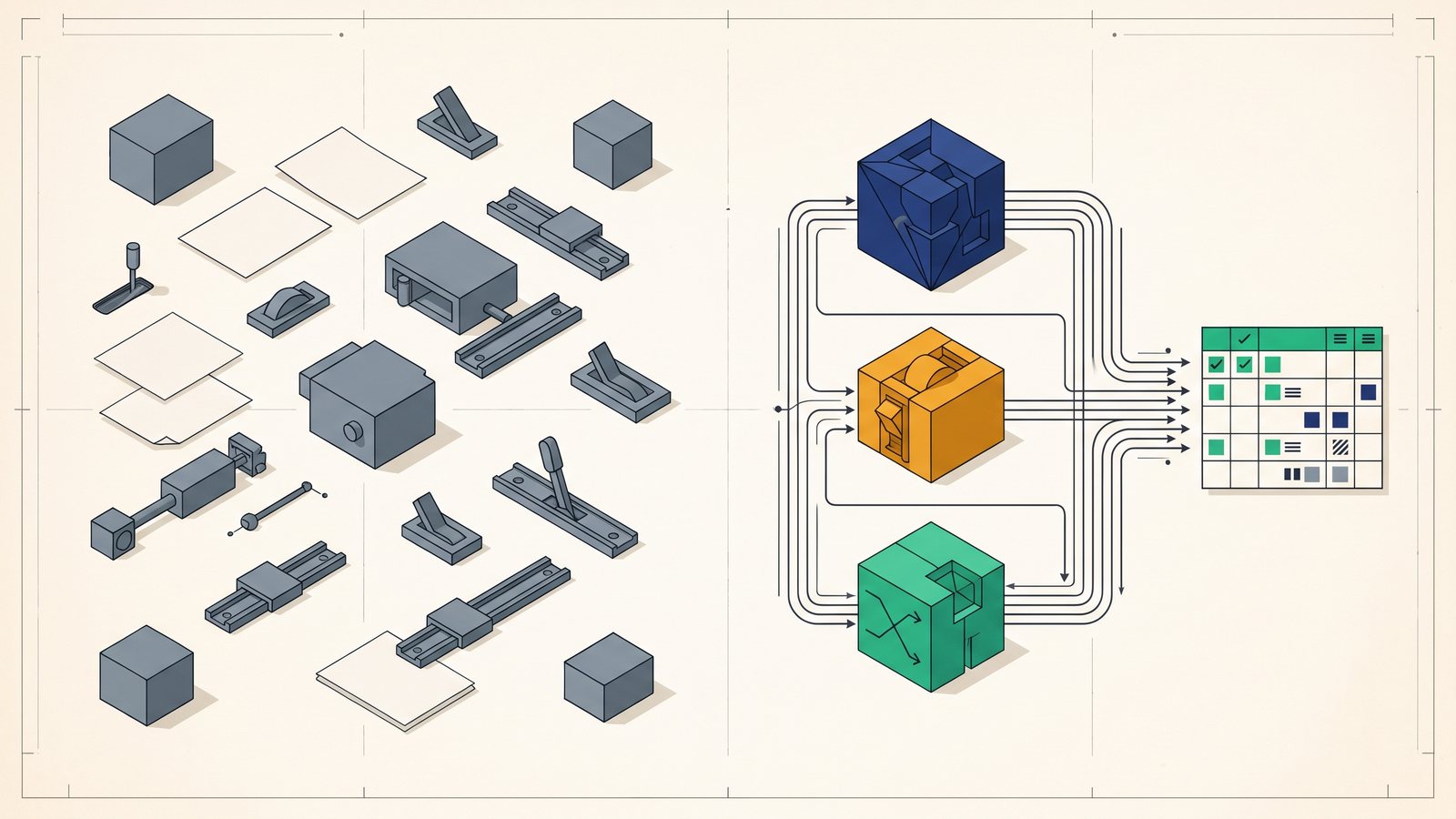
Before spending $5,000 to $15,000 per month scaling AI campaigns or custom agents, a B2B company needs three connected engines operating on shared data: a Demand Engine that earns search and AI citations, an Outreach Engine triggered by verified buying events, and a Follow-Up Engine that routes every hand-raiser in under five minutes.
1. The Demand Engine: Citation Architecture Over Blog Volume
Most agencies pitching AI marketing want to flood your blog with 1,500-word explainers. In 2026, unindexed or buried informational copy produces almost zero pipeline. Semrush's June 2026 AI Visibility Index, analyzing 126 million AI search prompts, found that organizations integrating traditional SEO and AI visibility into one unified workflow reported traffic and lead gains 81% of the time, compared to 36% for teams running separate lanes.
Winning those recommendations changes downstream buyer behavior. Similarweb's June 2026 referral study via Search Engine Journal showed that brands recommended in ChatGPT answers were 2.5 times more likely to earn a website visit within seven days, with 55.9% arriving via branded search and averaging 12 pages per session (11.8 minutes) versus 6.5 pages for standard visitors. Our Demand Engine builds commercial service pages and front-loaded comparison assets, applying the methodology in our GEO agency buyer's guide, so answer engines name your firm when buyers shortlist providers.
2. The Outreach Engine: Verified Buying Signals Over AI Spam
The fastest way an "AI marketing agency" damages a $1M to $10M B2B company is plugging an LLM copywriter into a broad firmographic database and blasting 1,000 cold emails a day from poorly configured domains. Personalizing an opening line with a scraped LinkedIn bio never turns a non-buyer into a deal.
List selection around a real event carries far more weight than AI prose tricks. In a controlled client experiment across 341 unique contacts on identical sending accounts in the same week, prospects selected from a dated regulatory audit trigger replied at 14.9% overall (7.5% human replies), while an untriggered firmographic list replied at 1.0% overall (0.5% human replies). That 15x spread came from who entered the sequence rather than prompt templates. Our Outreach Engine pairs dedicated sending infrastructure and dual business-email verification with live hiring, compliance, and leadership triggers, avoiding the traps detailed in our review of AI SDR tools.
3. The Follow-Up Engine: Unified CRM Data and Sub-5-Minute Routing
Strong demand and signal outbound still leak revenue when replies sit unworked inside a messy CRM. In Salesforce's 2026 State of Marketing dataset, marketing teams who unified customer data were 42% more likely to respond promptly and 60% more likely to deploy AI agents effectively than peers on fragmented records.
Our Follow-Up and RevOps Engine builds deterministic CRM hygiene before layering AI assistance on top: clear field ownership, instant lead routing under five minutes (see our speed-to-lead math), automated calendar reminders that protect show rates, and human review gates on warm outbound replies. Whether your team runs on HubSpot or Pipedrive (see our HubSpot vs. Pipedrive comparison), every inquiry and positive email reply flows into one pipeline view tied directly to held sales meetings.
How should a $1M to $10M B2B founder audit an AI agency proposal before signing?
Audit any AI marketing agency or AI automation agency proposal against five operational gates covering workspace ownership and sending-domain safety, plus primary-source verification, sub-5-minute CRM handoffs, and written milestone accountability. If a vendor sells monthly activity quotas or opaque bots without passing all five checks, hold your budget until the revenue architecture is in writing.
- Who owns the accounts, workflows, and sending domains if we part ways? Require every automation, ad account, and secondary sending domain to live inside workspaces your company owns rather than proprietary black-box agency portals.
- What prevents AI content or outbound copy from fabricating claims? Ask to see the exact citation verification gate for search content and the prospect-screening rules for outbound. Every commercial statistic must trace to a live primary source, and every outbound contact must pass dual business-email verification plus domain-level suppression checks.
- Where does the agency's scope stop when a prospect replies or fills out a form? Content shops usually stop at organic sessions, and outbound shops stop at forwarding an email. Insist on end-to-end CRM routing, stage clocks, and calendar reminders so leads convert into held calls.
- How does the pricing separate one-time build engineering from monthly operation? AgenticIndex's 2026 market data shows credible implementation starts around a $2,000 fixed entry build and $4,000 to $5,000+ monthly retainers. Be skeptical of $997 monthly packages promising autonomous pipeline, and equally skeptical of $15,000 monthly retainers billing for strategy slides before building infrastructure.
- What happens financially if a build milestone slips? Replace vague "3x output" claims with written milestone guarantees. At Perkins Growth Systems, we start with a free 48-hour Growth System Score (~5-minute diagnostic video, zero sales call required), move to a $2,000 system build-out, and operate the full three-engine growth system from $4,000 per month. If we miss an agreed milestone, that phase runs free until hit.
Frequently Asked Questions
How much does an AI marketing agency cost per month in 2026?
Published 2026 data from 307 AI agencies shows a median monthly retainer of $5,000 per month (ranging from $1,500 to $15,000 per month) alongside a $2,000 median one-time setup or entry build, excluding third-party software and API usage costs.
What is the difference between an AI marketing agency and an AI automation agency?
An AI marketing agency uses language models to produce search content, ad creative, and campaign assets faster, while an AI automation agency builds backend software workflows in tools like n8n, Make, or CRM pipelines without creating top-of-funnel buyer demand.
Should a $1M to $10M B2B company hire an AI agency or build in-house?
Most $1M to $10M B2B firms lack the $200,000+ payroll required to hire both a marketing strategist and a technical automation engineer in-house, making an owned, agency-built growth system faster and more capital-efficient provided you retain full workspace ownership.
How long does it take to see booked sales conversations from an AI growth system?
Signal-triggered outbound and automated CRM speed-to-lead workflows begin booking qualified sales conversations within the first three to five weeks after infrastructure warmup, while search and AI citation engineering compounds inbound pipeline starting around month four.
Keep Reading

Joseph Perkins
Joseph Perkins is the founder of Perkins Growth Systems. He spent 7 years leading marketing for a 4x Inc. 5000 firm from startup to exit, and now engineers search visibility, signal-based outbound, and RevOps and CRM automation systems for B2B companies.