Key Takeaways
- The term covers two unrelated products: an assistive layer around a human caller, and an autonomous voice agent that replaces one. Decide which you are shopping for before you compare a single vendor.
- Gong's data on more than 300 million calls implies an average rep needs roughly 400 dials per booked meeting while a top-quartile rep needs about 45. Skill moves that number around nine times harder than volume does.
- The FCC ruled in February 2024 that AI-generated voices are artificial voices under the TCPA, which puts a consent question in front of any autonomous agent pointed at a cold list.
- A randomized field experiment on more than 6,200 customers found that disclosing the caller was a bot cut purchase rates by over 79%, so the version of an AI voice agent most likely to be compliant is also the version that performs worst.
- Assistive tooling multiplies dials and administrative time. It does not move the two rates that decide the economics, which are whether people pick up and whether the caller can hold the conversation.
- Whatever fills the calendar, a booked conversation is only worth creating if somebody can absorb it. The Bridge Group's 2025 data puts a working SDR at about 4.1 quality conversations a day.
Cold calling AI is two products, and the search results will not tell you which one you are buying
Type the phrase into Google and you get a page at war with itself. Salesforce, holding one of the strongest positions on it, defines the category by what it excludes: "Unlike robocalling tools, the technology doesn't actually dial calls and interact with prospects." Its own FAQ asks whether AI cold calling is the same as a robocall and answers no. Directly alongside that sit a dozen voice-agent vendors selling software whose entire function is to dial a list and talk to whoever answers.
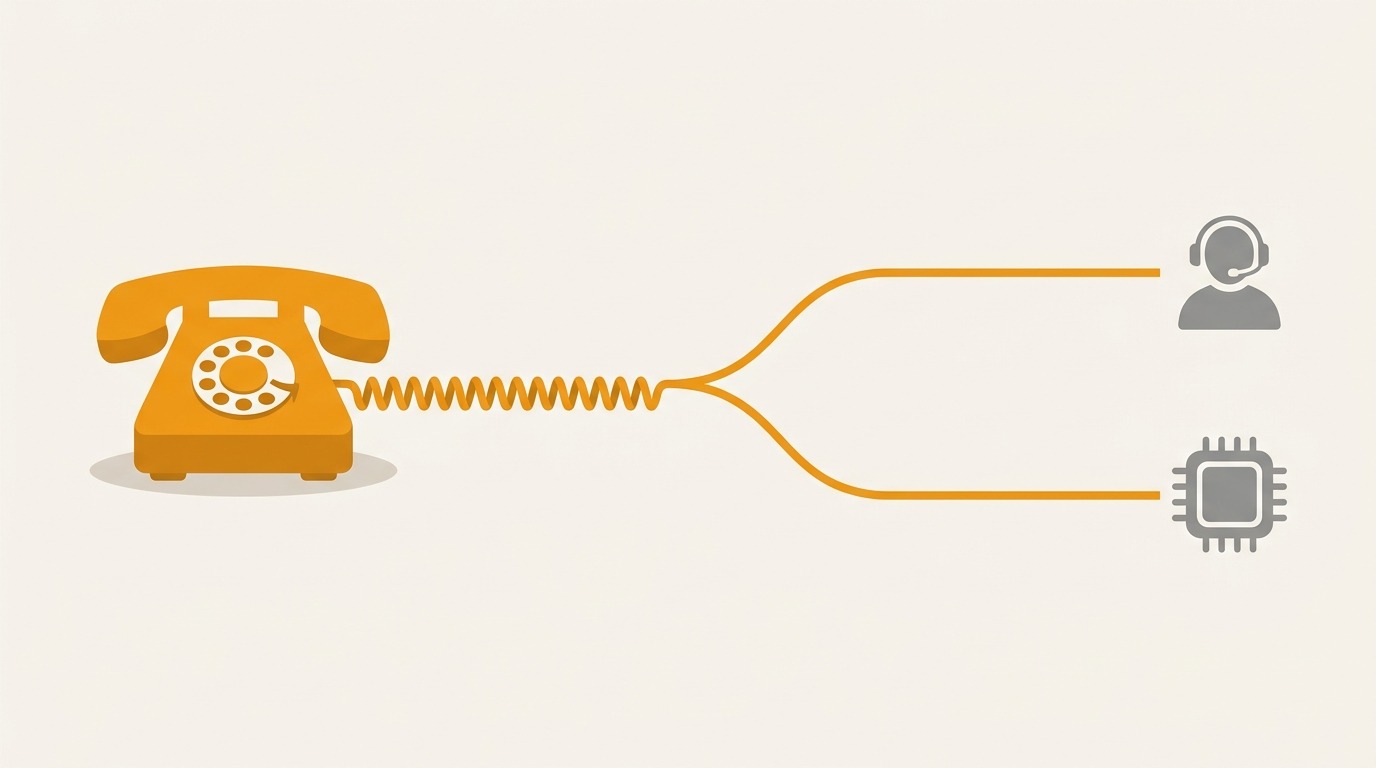
Both are describing real products. They are not describing the same product. One is an assistive layer that wraps a human caller in research, dialing speed, transcription and coaching. The other is a synthetic voice that places the call and handles the conversation with nobody on your side of the line. The first is a productivity purchase. The second is a regulated activity with a consent question attached, and the difference matters more than any feature comparison you will find on that results page.
So before comparing vendors, work out which of the two you are actually shopping for. The rest of this piece gives you the numbers to decide with, starting with the thing almost no page on this topic will show you: what a booked meeting by phone actually costs in dials.
What calling really returns, before AI enters the conversation
Gong analyzed more than 300 million cold calls on its platform and published the funnel in its cold calling research. Two rates matter. The average rep connected on 5.4% of dials while the top quartile connected on 13.3%. Once in a conversation, the average rep set a meeting 4.6% of the time and the top quartile 16.7%.
Multiply those out and the picture gets uncomfortable. An average rep needs about 18 dials to reach one conversation and about 22 conversations to book one meeting, which is roughly 400 dials per booked meeting. A top-quartile rep needs about 8 dials per conversation and 6 conversations per meeting, which is about 45. Same data set, same phones, a ninefold gap.
A second dataset lands in the same place on the meeting rate. Cognism's State of Cold Calling report, built on dial and meeting data from the team at We Have A Meeting, put the 2024 conversation-to-meeting success rate at 4.82%, within a rounding error of Gong's 4.6% average. Cognism's own 2025 pull had that rate roughly halve year over year, which it attributes partly to a harder market and partly to the dataset widening geographically. Two independent sources agreeing that a typical caller converts about one conversation in twenty is about as solid as benchmarks in this category get.
Hold on to the ninefold spread, because it is the number that decides what AI can and cannot do for you. The variable dominating cold calling economics is who is on the call. Volume is the smaller term.
The assistive layer multiplies the dials and leaves the rates alone
This is the version Salesforce is describing, and it is a legitimate purchase. Pre-call research, script preparation, automatic CRM logging, call transcription, conversation analysis and post-call follow-up all take real hours out of a rep's week, and a parallel dialer removes the dead time between connects.
The dialing gain is genuine and measurable. Orum, whose platform has handled over a billion outbound dials, reports an average pick-up rate of 5.3% across its customer base, which tracks Gong's 5.4% almost exactly. In its own comparison of power and parallel dialing it cites customer results including Crunchbase reporting a 400% increase in call productivity and seven hours a week saved per rep. Those customer figures come without a disclosed methodology, so treat them as reported outcomes rather than measured research. The direction is still right: dialing software genuinely does let one person place several times more calls in the same hour.
Now put that gain back into the arithmetic. If an average rep needs 400 dials per meeting and a dialer triples their daily dial count, they book three times as many meetings. That is worth paying for. What the dialer has not touched is either rate. Pick-up stayed at 5.4% and the conversation still converts at 4.6%, because those rates are set by who you called and what the caller said when they answered. The tooling made the funnel wider without making it better.
The Bridge Group's 2025 SDR research, surveying 351 B2B companies with a median revenue of 47 million dollars, shows where that ceiling actually sits. A working SDR averages 112 touches a day, 44 of them by phone, and gets 4.1 quality conversations out of it. Only 60% hit quota, the lowest figure in the study's history, and it has been running biennially since 2007. Triple the dials and you move the 44. You do not move the 60%.
Which is the honest case for the assistive layer, and it is a decent one. It buys back hours and widens the top of the funnel. It is a poor fit if your problem is that connects are not converting, because that is a targeting problem or a conversation problem, and you will get further by choosing who you call on a real buying signal than by calling more people faster.
The autonomous voice agent has a consent problem before it has a performance problem
Here is the part the vendor pages skip, and it is the reason Salesforce defines the category to exclude this product.
On 8 February 2024 the FCC issued a Declaratory Ruling in CG Docket 23-362 confirming that AI technologies generating human-sounding voices fall inside the Telephone Consumer Protection Act's existing prohibition on artificial or prerecorded voice messages. The Commission's reasoning is plain: such messages are artificial because a person is not speaking them. The ruling pointedly declines to carve out AI that purports to provide the equivalent of a live agent, which is precisely what a modern voice agent is sold as.
The practical consequence deserves saying slowly. The TCPA's restrictions on artificial and prerecorded voice calls bite hardest on wireless numbers and residential lines, and they turn on prior express consent. A cold list, by definition, is a list of people who have not consented to anything. On a modern B2B prospect list the direct dials are overwhelmingly mobile numbers. So pointing an autonomous voice agent at a cold list is a materially different legal act from having a person dial the same list, even though the vendor's onboarding flow makes them look like the same two clicks.
There is a follow-up document worth knowing about, because it is frequently misdescribed. In August 2024 the FCC issued a Notice of Proposed Rulemaking proposing that callers clearly disclose at the start of a call that AI-generated technology is in use. As of today that proposal has not been finalized into a binding rule. Anyone telling you a disclosure line makes an AI voice agent compliant is describing a rule that has been proposed rather than a rule that exists, and the consent requirement from the 2024 ruling applies either way. Several states have moved separately, including California, whose AB 2905 took effect in January 2025 and addresses disclosure of artificial voices on calls.
I am a marketer rather than a lawyer, and this is the point in the decision where you want actual counsel rather than a blog post. What I will say flatly is that the question is real and unsettled. None of the pages ranking above this one raise it at all.
Disclosure is exactly where the economics break
Suppose you resolve the consent question, or your counsel finds you a path through it. You are then very likely disclosing that the caller is a machine, either because a final rule requires it or because you decided not to mislead people. That decision has a measured cost.
The best evidence on it is a randomized field experiment published in Marketing Science by Luo, Tong, Fang and Qu, Machines versus Humans. More than 6,200 customers were randomly assigned outbound sales calls from either an AI chatbot or a human worker. Undisclosed, the bots converted about as well as proficient human agents. Disclosed before the conversation began, purchase rates fell by more than 79%. Calls also ran shorter, and the authors attribute the drop to customers judging a disclosed bot as less knowledgeable and less empathetic.
That study is from 2019 and ran on structured-script phone bots rather than current voice models, so the absolute figure will have moved. I am citing it because it is the only rigorous randomized evidence on this specific question I could find, and the absence of a 2025 or 2026 replication is itself informative given how much money has gone into the category. If the disclosure penalty had collapsed, somebody selling voice agents would have published the experiment proving it.
Read the two findings together and the bind is clear. The configuration most likely to satisfy a regulator is the configuration the research says performs worst. The configuration that performs is the one that does not tell people what they are talking to. That is a genuinely hard commercial position, and it is the reason I would not put an autonomous voice agent in front of a cold B2B list today.
None of which forecloses the category. Voice agents are already sensible on inbound calls, on qualifying people who filled in a form, on confirming or rescheduling booked meetings, and on reactivating contacts who previously opted in. Every one of those has either consent or an inbound trigger behind it, which is the whole difference.
How to decide, in the order that matters
Work through it in this sequence rather than starting from a vendor shortlist.
Start with whether calling is your constraint at all. If connects are converting and you simply cannot place enough dials, the assistive layer is the right purchase and a dialer will pay for itself quickly. If you are placing plenty of dials and nothing converts, more dials multiply the wrong number. Look at your targeting and your opener first, and compare what the same hour would return in signal-based email, where the cost of an extra attempt is close to zero.
Then check who absorbs the result. The Bridge Group's 4.1 quality conversations a day is a real ceiling, and the same limit applies to founder-led selling with considerably less headroom. A booked conversation is only worth creating if someone can take it, prepare for it and follow up afterwards. Programs that fill a calendar nobody can work do not produce revenue, they produce no-shows.
Then, if you are evaluating an autonomous agent specifically, get the consent question answered in writing before you get attached to a demo. Ask the vendor which TCPA basis they believe applies to cold mobile numbers and ask your own counsel the same question. A vendor who cannot answer it crisply has told you something useful.
And judge everything on held conversations rather than activity. Dials, talk time and connect counts all go up the moment you buy software. The number that decides whether the purchase worked is qualified conversations that actually happened, and whether the follow-up behind them holds. Our rundown of the AI SDR category goes further into how those vendors measure themselves, and the signal-based outreach checklist covers the targeting work that moves the conversion rate rather than the volume.
Cold calling still works, and the Gong data showing a ninefold spread between average and top-quartile callers is evidence of how much room there is at the good end. AI is genuinely useful for getting a caller to more conversations per hour. It has not yet solved the part that decides the outcome, which is what happens once somebody picks up.
Joseph Perkins
Joseph Perkins is the founder of Perkins Growth Systems. He spent 7 years leading marketing for a 4x Inc. 5000 firm from startup to exit, and now engineers search visibility, signal-based outbound, and RevOps and CRM automation systems for B2B companies.