
Key Takeaways
- B2B marketing automation is four jobs wired to one outcome: capture demand, route it, follow up fast, and report on sales conversations. It is not a platform you buy.
- Companies use only 33% of their martech stack's capability (Gartner), and the part they adopt first is usually the nurture drip, the layer with the least pipeline impact.
- Speed-to-lead is the highest-return automation you can run: responding within five minutes makes you 21x more likely to qualify a lead than waiting 30 (Harvard Business Review).
- With 67% of B2B buyers preferring a rep-free experience (Gartner, 2026), the capture layer feeds everything downstream. A follow-up system with nothing to follow up on is just overhead.
- Sequence the operating model before the platform. Define the booked-call number first, then wire capture and follow-up, then pick the smallest tool that runs all four jobs.
What B2B marketing automation actually does
Search "B2B marketing automation" and you get a platform tour: HubSpot versus Marketo versus Pardot, feature grids, pricing tiers. That answers a buying question nobody at a $1-10M B2B company is actually asking. The real question is narrower. What do I automate, and will it put more sales calls on my calendar?
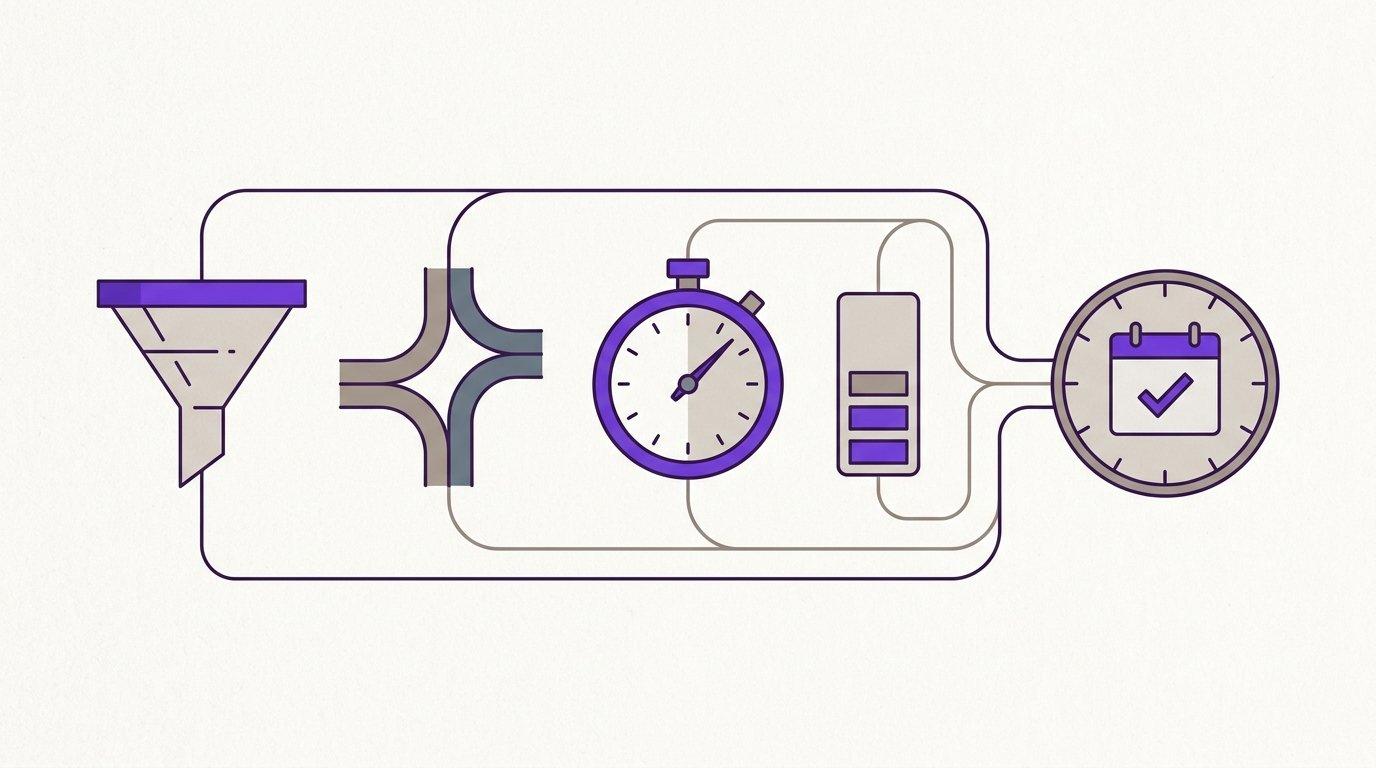
Strip away the platform marketing and automation does four jobs:
- Capture turns an anonymous visitor or a researching buyer into a known contact.
- Route sends that contact to the right next step.
- Follow up responds and stays in front of them without a person remembering to.
- Report tells you which of this booked a call.
Every feature a vendor demos sits inside one of those four jobs. Naming them this way matters because it shows you where your money leaks. A platform can be excellent at job three and useless at job one, and you would never know from the feature grid.
The backdrop for all four jobs has shifted. In a March 2026 Gartner survey of 646 B2B buyers, 67% said they prefer a rep-free buying experience and 45% reported using AI during a recent purchase. Buyers do most of the work before they talk to you. The job of automation is to stay useful across that self-serve stretch, not to fire more email into it.
Why most B2B automation underperforms
The disappointing returns rarely trace back to the tool. Gartner's Marketing Technology Survey found companies use just 33% of their martech stack's capability, down from 42% in 2022 and 58% in 2020, while spending a quarter of the marketing budget on technology. Firms buy capability, sign a multi-year contract, and switch on a sliver of what they paid for.
The sliver they do switch on is usually the wrong one. The nurture drip is the easiest piece to stand up, so it gets built first and polished forever. A prospect downloads a guide, gets a thank-you, then a blog link on day three, a case study on day seven, a soft ask on day fourteen. It feels like progress because there is something to look at. Meanwhile the contact who filled out a "talk to us" form on Tuesday sits in an inbox until Thursday, and the buyer who asked ChatGPT for firms like yours never found you at all.
That is the pattern across founder-led B2B companies. The comfortable middle is automated and the two ends, capture and fast follow-up, stay manual. The two ends are where the pipeline is.
There is a second reason the returns disappoint, and it is structural. HubSpot's 2025 research found 35% of marketers say there are too many tools that do the same thing and do not connect to one another. Each tool automates its own slice and hands off to the next one through a manual export or a brittle sync. The buyer feels the seams: a chatbot that cannot see the form they filled out, a sales email that ignores the page they spent ten minutes on. Automation that is not connected is not really automation. It is four part-time robots that do not talk.
Capture: be findable where buyers research
With two-thirds of buyers preferring to self-serve, the first job is being present and answerable in the places they look before any form gets filled out. That means search results, AI answer engines, and a site that responds to a question instead of pitching. This is the SEO and answer-engine layer, and it sits upstream of every other automation job. A follow-up system with nothing to follow up on is overhead with a monthly fee.
Capture also includes the moment of conversion. When a buyer who has been reading for three weeks finally decides to act, the path from "interested" to "known contact" should be one click, not a form that asks for a phone number and a job title and a company size before it lets them book. The automation here is unglamorous: a working booking flow and a form that fires the instant it is submitted instead of feeding a nightly export. None of it shows up in a platform demo, and all of it decides whether the rest of your stack ever sees the contact. For how this connects to trigger-timed outreach, see our breakdown of AI for sales prospecting.
Route and follow up: the speed layer most firms skip
Routing is one decision repeated reliably. Does this contact get a fast human touch now, or does it go into nurture until a buying signal fires? You do not need account-based scoring models with twelve weighted variables to make that call. You need a rule that catches the "ready" contacts and gets them to a person or a booking link inside minutes. The CRM automation that connects capture to routing to follow-up is the spine here, and simpler rules beat elaborate ones that nobody trusts.
Follow-up speed is the highest-return automation you can run, and it is the one firms skip. The landmark study on this, published in Harvard Business Review by James Oldroyd, Kristina McElheran, and David Elkington, found that firms responding to a web lead within five minutes were 21 times more likely to qualify it than firms that waited 30 minutes. Trying within the hour made a firm nearly seven times more likely to qualify a lead than waiting just past it. The study read over 100,000 leads across more than 2,000 companies, and the finding has held up across every replication since.
Now set that against how B2B firms actually perform. Independent measurements put the average first response to an inbound B2B lead at well over a day. The gap between what the buyer expects and what the firm delivers is the single cleanest place automation pays for itself. An instant acknowledgment, an instant routing to a booking link, and a persistent sequence of attempts cost almost nothing to wire and recover leads you are currently losing to whoever replied first. This is the layer where a lean team beats a bigger one, because the software does the remembering.
Here is the wiring in practice. A buyer submits a form at 9:14 PM. By 9:14 they have an email or text confirming you got it, with a link to grab time on your calendar directly. If they book, the call lands on your schedule and a brief goes out so you walk in prepared. If they do not book within a few hours, a short sequence follows: a check-in the next morning, a relevant proof point two days later, a final nudge after that. A human steps in the moment the buyer replies. None of that requires you to be awake at 9:14 PM, and all of it happens before a competitor who batches lead follow-up into a Monday block ever picks up the phone. What matters is when the clock starts. It starts the instant the form fires, while a batched queue starts whenever someone next logs in.
Measure one outcome: sales conversations
A nurture report full of open rates and click rates tells you the email engine is running. It does not tell you whether the system is working. For a founder still personally running sales, the number that survives a budget review is booked sales calls, and every automation job should ladder up to it.
That single metric also exposes the martech waste from earlier. If you cannot trace a booked call back to the capture source, the routing rule, and the follow-up that produced it, you are paying for capability you cannot see. Reporting is the job that turns the other three from activity into evidence. Five years of running marketing at an Inc. 5000 firm taught the same lesson the Gartner data shows: the stack only earns its keep when one number at the end proves it did.
Sequence the operating model before the platform
The most common and most expensive mistake is buying the platform first and hoping it imposes a process. It never does. The platform inherits whatever mess you had and adds a login.
Build in this order. Define the sales-conversation goal and how you will count it. Wire capture so researching buyers can find you and convert in one step. Wire fast follow-up so the ready contacts hit a human or a booking link in minutes. Add routing rules to separate ready from not-yet. Add reporting that ties conversations back to source. Only then choose the smallest tool that runs all four jobs together, because the integration is the product. The disconnected-stack problem from earlier is what happens when you buy before you sequence: every tool you add without a job to do becomes another seam the buyer falls through.
This is why the work belongs in one coordinated follow-up automation system rather than four tools bolted together. Capture feeds routing, routing feeds follow-up, follow-up feeds reporting, and reporting tells you where to spend next. Run them as separate projects and the handoffs between them, the exact spots the Gartner and HBR data flag, are where your booked calls disappear. If you want the build order in detail, the Follow-Up Automation Playbook lays out each job and the smallest setup that covers it.
Marketing automation for a B2B company is not a software purchase. It is the decision to wire four jobs to one outcome and to fix the handoffs between them before you shop. Get that order right and a three-person team books like a ten-person one. Get it wrong and you join the firms paying for 67% of a stack they never turned on.
