Key Takeaways
- Automation multiplies your existing reply rate rather than creating one. Lavender's 231,818-email benchmark puts A-grade copy at a 5.4% reply rate, a 58% lift that comes from the writing, which no sending platform improves.
- Fixing copy before scaling volume produces roughly 162 replies per 3,000 contacts against 102 for the automate-first path, on identical tooling. The order of operations moves the result by about 60%.
- Google requires bulk senders above 5,000 Gmail messages a day to hold Postmaster spam rates below 0.3%, and above that threshold they are ineligible for mitigation until the rate stays under it for seven consecutive days. At 5,000 sends that ceiling is fifteen complaints.
- Gartner surveyed 632 B2B buyers and found individual-level personalisation had a 59% negative impact on buying-group consensus, while buying-group-relevant content improved it by 20%. The feature most automation tools sell is the one that measured backwards.
- The dependable return is follow-up automation rather than first touch: no deliverability exposure, and it recovers conversations you have already paid to create.
The short answer
Outbound sales automation is the set of systems that source contacts, verify them, send sequences, handle replies and push the result into a CRM without a person doing each step by hand. It changes how much outbound you can run. It does not change how well your outbound works.
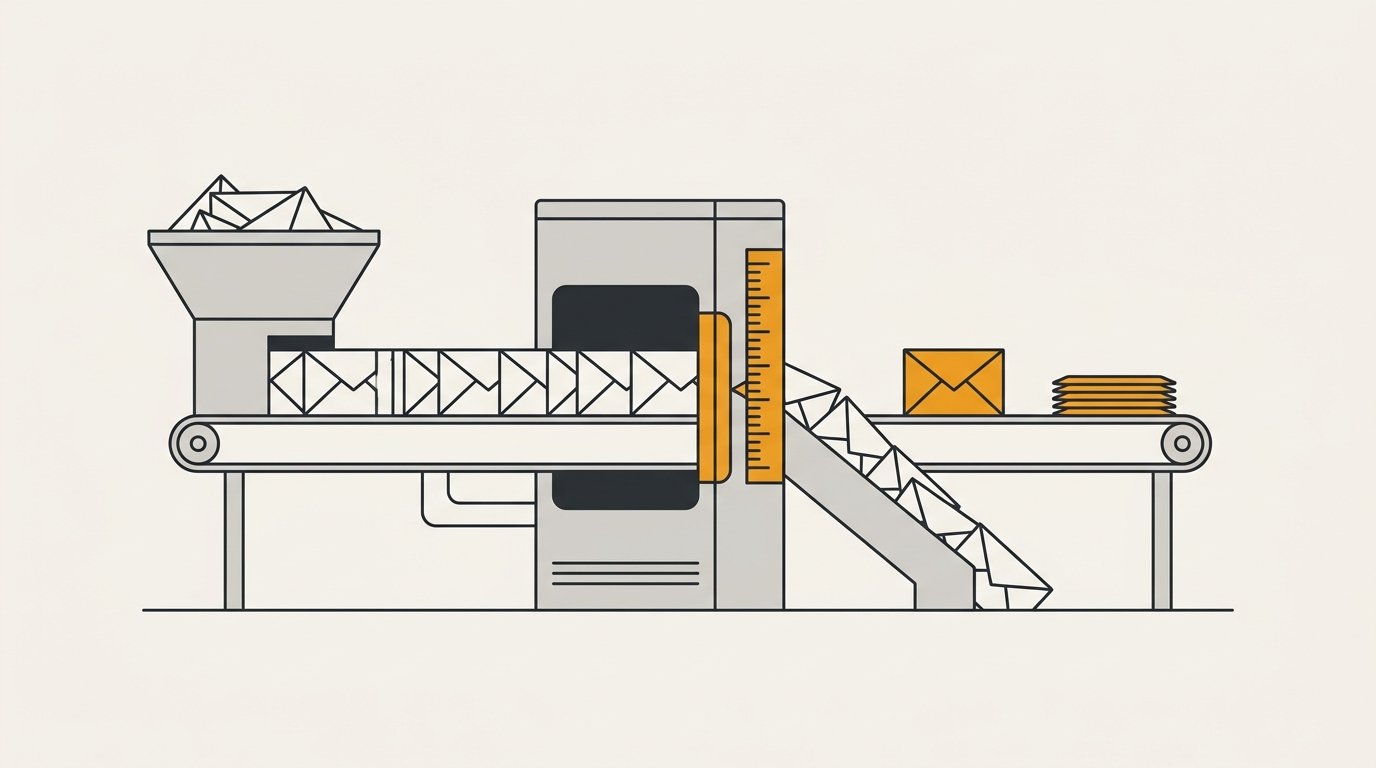
That distinction decides whether the spend pays. A motion that books meetings from 1% of the people it contacts will, once automated, book meetings from roughly 1% of a larger number. A motion that books nothing will produce nothing faster, and it will burn sender reputation you cannot buy back on the way. Automation is a multiplier applied to whatever your outbound already does, and a multiplier needs something to multiply.
Almost every guide on this keyword is published by a company selling one of the layers. That is why they all describe the build and none of them describe the ceiling. The ceiling is the interesting part.
What outbound sales automation actually covers
Strip the category down and there are four layers, each doing a different job.
Sourcing and enrichment. Building the contact list: firmographic filters, job-change and hiring signals, waterfall email enrichment across several providers, verification. This decides who gets contacted.
Sending infrastructure. Domains, mailboxes, authentication records, warmup, rotation, daily caps. This decides how many messages can leave without the mail arriving in a spam folder.
Sequencing and reply handling. Multi-step cadences, branching on reply, classification of inbound, meeting booking. This decides what happens after the first send.
CRM follow-up and routing. Reminder logic, lead assignment, no-show recovery, data hygiene, pipeline updates. This decides what happens to a lead after it becomes interesting.
Three of those four are throughput problems. They move volume through a pipe faster and with fewer human touches. Only the first one touches the question that determines the outcome, which is whether the person receiving the message has the problem you fix. No layer in the stack is persuasion. That work is still the copy and the targeting, and the copy and the targeting are the parts nobody has automated well.
The multiplier, with real numbers
Lavender's Cold Email Benchmark Report, updated in March 2026, analyses 231,818 cold emails as of 4 February 2026, drawn from roughly 50,000 inboxes connected to its email coach, with automated out-of-office replies and bounce notifications excluded. Emails scoring an A grade on the report's writing measures reply at 5.4%, a 58% lift over lower-graded copy.
Read that as an operator and it tells you where the gain sits. The lift came from the writing. Automation does not write, and no sending platform improves a reply rate by sending the same message more efficiently.
Put numbers against it. Say you contact 1,000 people a month with average copy at a 3.4% reply rate. That is 34 replies. Two paths from there:
Automate first. Triple contact volume to 3,000 at the same 3.4% and you get about 102 replies. You have also tripled your enrichment bill, tripled your daily send volume, and tripled the number of people who might mark you as spam.
Fix the copy first, then automate. Get to 5.4% at 1,000 contacts and you are at 54 replies from the same list and the same infrastructure. Then triple the volume and you are near 162 replies, on the identical tooling that produced 102 on the other path.
Same platforms, same spend, sixty per cent more conversations, decided entirely by the order of operations. This is the arithmetic that vendor content skips, because the variable that moves the result is not the thing being sold.
Google capped the volume-only version of this
The other reason volume alone stops working is that the mailbox providers put a number on it.
Google's email sender guidelines require senders of more than 5,000 messages a day to Gmail accounts to meet bulk-sender requirements, in force since 1 February 2024: SPF and DKIM authentication, a DMARC record, valid forward and reverse DNS, and one-click unsubscribe. The instruction that governs everything else is the spam rate. Google says to keep the rate reported in Postmaster Tools below 0.3%, and its stricter guidance is to stay under 0.10% and never reach 0.30% at all.
There is a penalty attached. Google's sender guidelines FAQ states that from June 2024, bulk senders with a user-reported spam rate above 0.3% are ineligible for mitigation, and become eligible again only once the rate stays below 0.3% for seven consecutive days.
Work out what that means at volume. A 0.3% ceiling on 5,000 messages a day is fifteen complaints. Fifteen people out of five thousand, and you are over the line and outside the mitigation path for at least a week. The constraint is expressed as a rate, so scaling does not dilute it. Sending more mail raises the absolute number of people you irritate while holding the allowable percentage fixed, which is why the same campaign that ran cleanly at 300 a day can fall over at 3,000.
This is the mechanism behind most of the outbound programmes that stop working without an obvious cause. The copy did not get worse. The volume got higher and the complaint rate stayed the same, which was enough. If you are scaling sends, the technical floor matters more than the sequence, and it is worth reading our breakdown of cold email deliverability and how to build cold email infrastructure before you raise a single daily limit.
The personalisation trap Gartner measured
Here is the finding that should change how you configure an automation stack, and it appears in none of the guides competing for this keyword.
Gartner reported in May 2025 on a survey of 632 B2B buyers conducted in August and September 2024. B2B buying groups range from five to sixteen people across as many as four functions. Groups that reach consensus are 2.5 times more likely to report that the deal was high quality. Then the part that matters here: content tailored to buying-group relevance improved consensus by 20%, while content tailored to the individual had a 59% negative impact on buying-group consensus.
Now consider what almost every automation product in this category sells. It scrapes a LinkedIn post, a recent funding round, a podcast appearance or a job change, and writes an opening line about that one person's individual situation. Individual-level personalisation, generated at scale, is the headline feature of the entire AI-SDR wave.
Gartner's data says that is the variety of relevance that damages the thing you actually need. You are not trying to impress one person. You are trying to give one person something that survives being forwarded to the four to fifteen colleagues who have to agree before anything gets bought. A message about a prospect's podcast appearance does not survive that forward. A message about a problem their function has does.
The practical consequence is counterintuitive: automating personalisation harder can make the programme worse, and the fix is to move the personalisation up a level. Write to the role's problem rather than the person's biography, and select the account on a real buying signal instead. That is the argument behind signal-first outbound, and it is the reason a well-targeted generic message routinely outperforms a badly-targeted personalised one.
Where automation genuinely pays
None of this argues against automating. It argues about which layer to automate.
Salesforce's State of Sales report for 2026, published 3 February 2026, found the average seller spends 40% of their time actually selling, with Gen Z reps down at 35% and losing roughly two hours every week to manual data entry. HubSpot's 2025 State of Sales report, published 9 September 2025 from a survey of 995 sales professionals fielded in June 2025, found only 8% of reps use no AI at all, and 84% say it saves time and improves their process.
Both point at the same place, and it is not the first touch. The reliable return sits in the mechanical work that humans do badly and resent doing: follow-up timing, reminders before and after a booked call, routing a reply to the right person while it is still warm, recovering a no-show, keeping records accurate enough to report on.
Follow-up is memory work. Memory is precisely where a system beats a person, because the system does not get busy. A founder running sales personally does not forget to follow up because they are careless. They forget because a client escalated on Thursday. Automating that layer converts effort you are already spending into conversations you are currently losing, and it does it without touching your spam rate. It is also the layer with the least competitive attention, since CRM automation and lead routing make for worse marketing copy than an AI that writes emails. Our Follow-Up Engine exists for exactly this reason.
The order of operations
If you are building this, the sequence matters more than the tool selection.
Prove the motion by hand first, at small volume, until you have replies you can read and count. You cannot debug a 3,000-contact programme, because everything correlates with everything.
Fix the list and the copy before you touch the sending stack, because those are the only two variables that move a reply rate, and the Lavender spread shows the size of what is available.
Automate follow-up before you automate first touch. It is lower risk, it has no deliverability exposure, and it recovers conversations you have already paid to create.
Automate sending last, and raise limits slowly when you do. Treat the Postmaster spam rate as the governor on the whole programme rather than a number you go looking for after something has already broken.
Then judge the result on one number. Not opens, which are no longer measurable in any honest way. Not sends, which automation will happily inflate. Booked sales conversations, which is the only figure that connects the stack to revenue. The Outreach Engine we build for clients is scored on that and nothing else, and if you want the targeting criteria we use before any of this gets switched on, the signal-based outreach checklist is the version we work from.
Automation is worth building. It just belongs at the end of the project rather than the beginning, because it makes whatever you already have bigger, and bigger is only good news if the thing being enlarged was working.

Joseph Perkins
Joseph Perkins is the founder of Perkins Growth Systems. He spent 7 years leading marketing for a 4x Inc. 5000 firm from startup to exit, and now engineers search visibility, signal-based outbound, and RevOps and CRM automation systems for B2B companies.