
Key Takeaways
- A prospecting tool has one real job: it shortens the time and effort between a buying signal and a relevant first touch. Judge every tool against that one job before you compare feature lists.
- Every stack does four jobs: find who, know when and why, reach them, and turn the reply into a booked conversation. Most teams over-buy the first job and starve the middle two.
- The find layer is now a commodity that decays. HubSpot puts B2B contact data decay near 22.5% a year, so a bought list is a depreciating input, not an asset.
- AI reorganized the market, but Gartner found it saves sellers about 4.8 hours a week while 72% of teams reinvest almost none of it. A tool you bolt onto an unchanged process does not become a system.
A prospecting tool does not create pipeline
A sales prospecting tool has one real job. It shortens the time and effort between a buying signal and a relevant first touch. That is the whole value. A tool does not create demand, and it will not make a busy stranger want to reply. It takes work you would otherwise do by hand and makes that work faster or cheaper.
Hold that definition up against how most stacks get built and the mismatch is obvious. Teams buy for the step that is already easy (finding names and emails) and leave the steps that actually gate a booked conversation to memory and good intentions. Then they wonder why a bigger tool budget produced the same flat calendar.
This piece is a way to read the category. Before you compare Apollo to ZoomInfo to Clay to the newest AI SDR, sort every tool by the job it does. Once the jobs are clear, most of the buying decisions answer themselves, and the spending moves to where meetings are actually won or lost.
The four jobs every prospecting tool is really doing
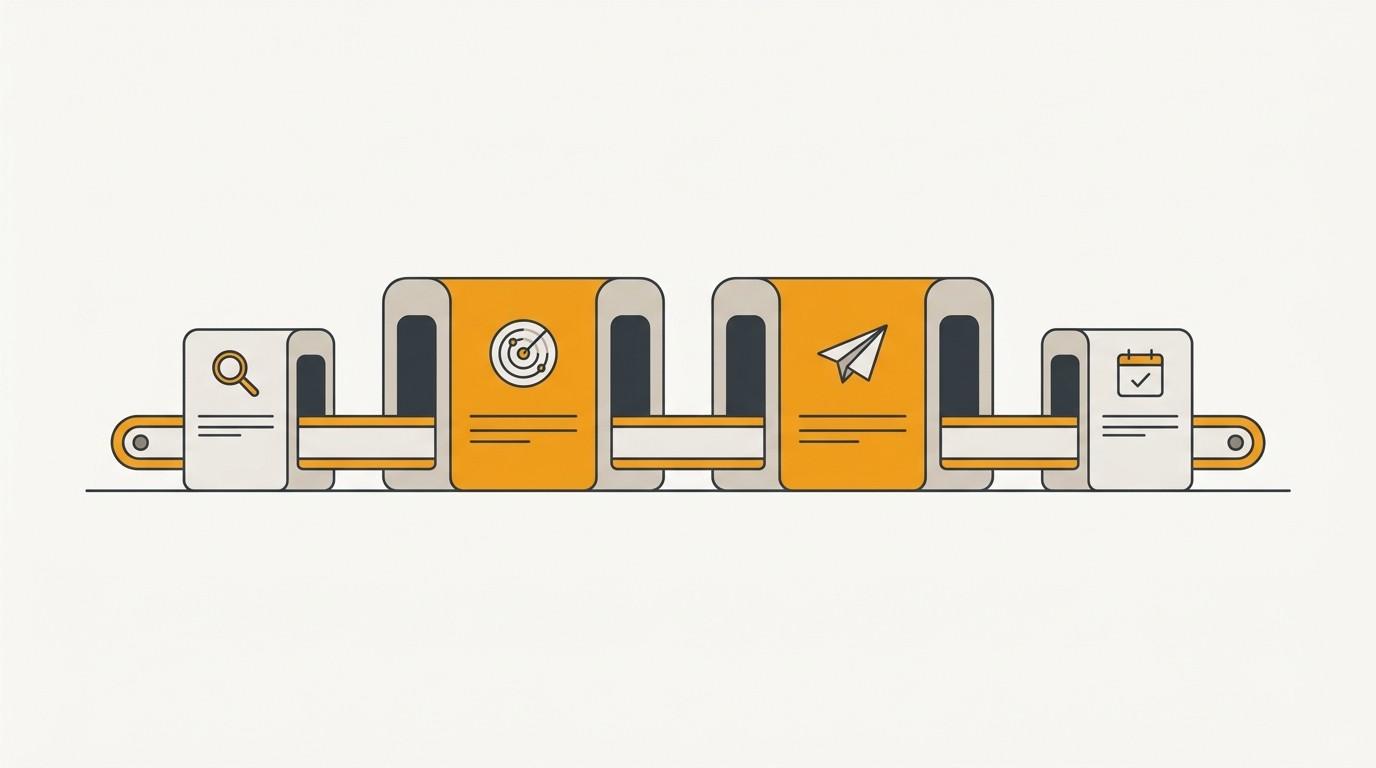
Strip the branding off the prospecting market and you find four jobs. Every tool sells itself as more, but each one mostly does one of these well.
Find: who. Contact databases and enrichment providers. They turn an ideal-customer definition into a list of named people with reachable addresses. Apollo, ZoomInfo, and Clay live here, along with the enrichment layer that fills in the gaps.
Trigger: when and why. Intent data, website visitor identification, hiring and funding alerts, technology-change monitoring. These tools tell you which accounts have a reason to hear from you right now, so a first touch lands on a live problem instead of a cold guess.
Reach: deliver and sequence. Sending platforms, deliverability infrastructure, and the sequencing logic that decides who gets which message and when. This is where the email either arrives in a primary inbox or quietly dies in spam.
Convert: reply to booked. Reply detection, routing, meeting scheduling, and the CRM handoff. A positive reply that sits for six hours, or lands with the wrong rep, is a meeting you already paid for and then dropped.
Read left to right, these jobs are a conveyor. A weak station anywhere caps everything downstream. A perfect list reached through a burned domain still books nothing. A great signal that routes to a rep who answers a day late still loses the deal. The stack is only as strong as its weakest job, which is exactly why buying more power for a job you already do well is the most common way to waste money in outbound.
The job most stacks over-buy, and the one they starve
Almost every team over-invests in Find. It is the most crowded, most demoed, most discounted corner of the market, so it feels like the center of prospecting. It is not. It is the input.
Two facts should reset how much a contact database is worth to you. First, the data is a commodity: several providers sell overlapping records pulled from the same public sources, which is why "more contacts" rarely changes results. Second, and more important, that data is perishable. HubSpot's database decay research puts B2B contact data decay near 22.5% a year, roughly 2% a month, as people change jobs and email addresses go dead. A list you buy today starts depreciating the day it lands, the way a car does the moment it leaves the lot. Paying a premium for a slightly larger version of a thing that rots at a fifth per year is a poor trade.
We made the fuller version of this case in our breakdown of B2B data enrichment: the smart move is to treat data as a refill you pull on demand. Get accurate-enough contacts, then spend your attention and budget further down the line.
Because the job that most teams starve is Trigger, and it is the one with the highest return. The reason is simple. Who you email and whether there is a real reason to email them now drives more of the reply outcome than any subject line. Intent and signal tools exist to answer the "why now," yet they are the first thing cut when a budget tightens and the last thing bought when it loosens. That is backward. Reaching the right account on the week it starts hiring for the role your product supports, or the month it adopts a technology you plug into, beats reaching a larger list with nothing behind the message. This is the core of what we call signal-first outbound, and it is where a modest tool spend produces the clearest lift.
What AI actually changed in the prospecting stack
AI did not add a fifth job. It made two of the four jobs much cheaper, and in doing so it changed which tools matter.
The scale of adoption is real. Salesforce's 2026 State of Sales report, built on a survey of 4,050 sales professionals, found 87% of sales organizations now use some form of AI for tasks like prospecting and forecasting, and 55% use AI specifically for prospecting. The same report found high performers are 1.7 times more likely than underperformers to use prospecting agents. Gartner expects the shift to keep running: in its analysis of AI in sales, it projects that by 2027, 95% of seller research workflows will begin with AI, up from less than 20% in 2024.
Where AI helps is narrow and worth naming. It compresses account research and drafts personalized first lines from public signals. It also monitors accounts for the triggers a human would never track by hand. In other words, it makes the Find and Trigger jobs faster and cheaper. That is genuinely useful, and it explains the rise of the AI SDR: a tool that promises to run research, list-building, and first-touch outreach with little human involvement.
The AI SDR question is worth answering honestly, because the category is loud. Autonomy is not the same as judgment. A tool that can send a thousand relevant-looking emails without a human in the loop will happily scale a bad list or a burned domain faster than you ever could by hand. Gartner's own read is a caution here: it predicts AI agents will outnumber human sellers roughly tenfold by 2028, yet fewer than 40% of sellers expect those agents to improve their productivity. The right way to buy an AI SDR is the same as any other tool. Decide which job you want it to do, hold it to that job, and keep a human on the two places machines are still weak: deciding the account is worth the touch, and handling the reply that comes back.
The reinvestment trap: a tool is not a system
Here is the finding that should change how you shop. Gartner surveyed sales leaders and found that AI tools save sellers an average of 4.8 hours a week, and that 72% of sales organizations reinvest almost none of that time into higher-value work. The hours get saved and then evaporate. As Gartner's Dan Gottlieb put it, "sales productivity does not stall because reps forget how to sell. It stalls because the system quietly caps them."
That is the trap the whole prospecting-tools market walks into. A tool creates capacity. A system decides what to do with it. Buy a faster list-builder and you have a faster list-builder, which frees up an afternoon; unless the afternoon is spent on the jobs that actually book conversations, the tool has changed your cost while your calendar stays flat.
Salesforce found the same gap from the other side. Its data puts reps at about 60% of their time on non-selling work, while sellers who genuinely partner with AI tools are 3.7 times more likely to hit quota. The tool alone is not the variable. The reorganized workflow around it is.
This is why the honest answer to "which prospecting tool should I buy" is usually "fix the sequence first." A tool you bolt onto an unchanged process inherits every weakness that process already had. The email arrives faster and still misses on relevance. The list is bigger and still routes replies into a shared inbox nobody watches. The point of an Outreach Engine is that the four jobs are wired to run as one motion with owners and handoffs, so the capacity a tool creates lands somewhere that produces a booked conversation.
How to choose without buying six overlapping tools
Once the jobs are clear, a short set of questions replaces the endless feature comparison.
Start by naming your binding constraint. Walk the conveyor and find the station that is capping the rest. If replies come in and go stale, your problem is Convert. No better database fixes that. If your sends land in spam, your problem is Reach. Read our piece on cold email deliverability before you spend a dollar on more contacts. If you are emailing fine people for no reason they can see, your problem is Trigger. Buy for the constraint. The slickest demo is rarely aimed at it.
Then buy one tool per job. Overlap is where budgets bloat and data gets messy. Most teams need exactly four tools, one per job, and no more. When a single platform genuinely covers two of the jobs well, that is a reason to consolidate, and we walk through how to assemble a lean version of this in our guide to B2B prospecting tools.
Test any tool against volume it cannot fake. A trial that produces a nicer-looking list proves nothing, because the list was never the constraint. A trial that produces more booked conversations in a month is the only result that counts. Give a new tool a real target on your worst-performing job and measure whether meetings actually go up.
Finally, decide who owns the reinvested time before you sign. If a tool frees five hours a week, write down where those hours go, whether that is deeper research on your top segment or faster handling of the replies you already get. A tool without that plan just funds the reinvestment gap Gartner measured. If you want a running checklist for wiring the signal-to-touch path, our signal-based outreach checklist lays out the steps in order.
The market will keep launching tools that promise to do all four jobs at once. Some will get close. None of them will decide, on your behalf, which account is worth interrupting and what to say when the reply lands. Those two calls are still yours, and they are still where the pipeline is actually made. Buy tools to give yourself more room to make them well.
