
Key Takeaways
- Waterfall enrichment is an economics problem before it is a tooling problem. The order you query providers in matters more than how many you stack.
- Sequence providers by hit rate times unit cost on your specific ICP. The best first vendor for an MSP list is rarely the best first vendor for a SaaS list.
- Treat verification as its own stage. An unverified email that bounces costs more in sender reputation than three verified misses cost in vendor fees.
- Stop the waterfall when marginal cost exceeds marginal value. Most teams chain five to seven providers when the math says two or three is the cutoff.
What waterfall enrichment is, and what every guide gets wrong
Waterfall enrichment is the practice of querying multiple B2B data providers in sequence for a single record, paying only for the providers that return a match. If the first vendor returns a verified mobile, you stop. Otherwise the request falls through to the second, the third, and so on until you hit a match or exhaust the stack.
The mechanics are straightforward. The economics are not.
Most guides on this topic, including the ones currently ranking on page one for this keyword, frame waterfall enrichment as a tooling decision. Pick the right orchestration platform, plug in five to seven providers, and watch your coverage climb. Clay's own marketing puts the lift at 2-3x over single-provider models, with one of their reference waterfalls hitting 79% coverage on personal emails versus ZoomInfo's roughly 30% mobile coverage.
Those numbers are real. They are also the easiest part of the problem to solve. The harder questions are about sequence, verification, and where to stop. They decide whether a waterfall is profitable for a specific business. Most guides skip them entirely because the answer is "it depends on your ICP," which does not sell software.
This post is the operator's version. We run waterfall enrichment for B2B professional services firms every day at Perkins Growth, and the framework below is what actually drives the numbers.
Why the SERP gets this wrong
Almost every article ranking for "waterfall enrichment" is published by a vendor with a stake in the answer. Clay sells orchestration. Findymail sells email verification. Crustdata sells data. FullEnrich sells a managed waterfall. Each piece is a thinly disguised pitch for the publisher's product, and each piece tells the same three-part story: data is decaying, single providers cannot keep up, here is our tool.
The data-decay half of that story is true and useful. HubSpot, citing MarketingSherpa research, pegs B2B contact decay at 2.1% per month, or roughly 22.5% per year. ZeroBounce's 2025 analysis of 11 billion verified emails put list-level decay at around 23% annually. IndustrySelect's twelve-month tracking study of 1,000 business cards showed job titles change for 65.8% of contacts in a year, phone numbers for 42.9%, and email addresses for 37.3%. Single-provider databases cannot keep up. That part is real.
The "stack more providers" half of the story is where the analysis falls apart. It treats the waterfall as a coverage problem when it is really a cost problem. Coverage is easy to buy. Chain enough vendors and you will eventually find a match for almost any record. The question is whether finding that match was worth what you paid in vendor fees, verification cost, and sender-reputation risk.
A good waterfall is the one where the marginal dollar spent on the last provider returns more than a dollar of pipeline value. That calculation is invisible in a vendor-written guide.
Three principles the vendor blogs miss
1. Sequence by hit rate times unit cost
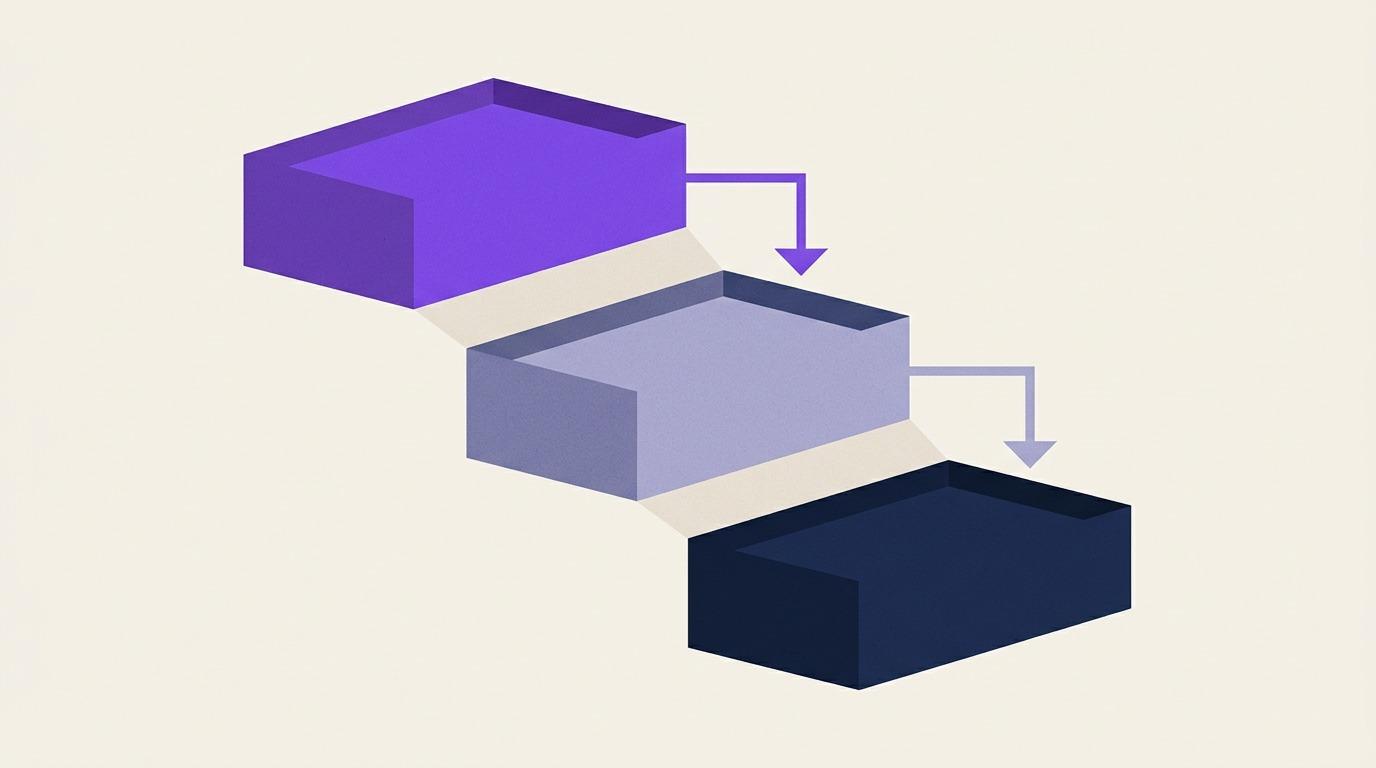
The first provider in your waterfall does the most work. It runs against every record. Whatever percentage of your list it covers, you pay full price for. Every record it misses falls through to provider two, which runs against the remaining list, and so on.
Provider one's economics dominate the entire waterfall. Put a high-cost generalist first because it has a recognizable brand, and you pay premium per-match rates on records a cheaper specialist could have handled.
The right first provider is the one with the highest hit rate on your specific ICP at the lowest unit cost. For a list of US-based managed-service providers between five and twenty-five employees, that vendor is almost never the same as the right first vendor for a list of mid-market SaaS founders. Hit rates vary by firmographic. Pricing varies by volume tier and region. The intersection of those two is where sequence is decided.
Perkins Growth clients have cut waterfall cost per verified contact by 30-40% just by reordering the same set of providers based on actual hit-rate testing on their own ICP. Same vendors, same orchestration, different sequence.
The diagnostic is simple. Run a 500-record test through each provider as a first-pass standalone. Record cost-per-match for each. The vendor with the lowest cost-per-match on your ICP goes first. This is unglamorous work. It is also where the money is.
2. Verification is its own stage
The dirty secret of waterfall enrichment is that "match rate" and "deliverable rate" are different numbers. A provider can return an email that looks valid, scores well on its internal verification, and still bounce when you actually send to it.
Crustdata's analysis notes that most B2B providers verify roughly half their returned records to a high-confidence threshold. The other half are educated guesses: pattern-matched email addresses, role-inferred mobiles, catch-all domains. They count as matches in your provider's billing system. They do not count as deliverable contacts in yours.
This matters because in 2024 Google and Microsoft tightened enforcement on bulk-sender authentication and bounce thresholds. Bounce rates above 0.3% in either inbox now meaningfully damage sender reputation across your entire domain, beyond the specific sending account. A waterfall that returns 80% match rates with 30% non-deliverable noise is worse than a 50% waterfall with 5% noise. The first one quietly burns the inboxes you spent six months warming up.
The fix is to treat verification as its own stage that runs after the enrichment waterfall. A dedicated verifier, one that does SMTP handshake checking against the actual mailbox rather than MX-record validation alone, catches the difference. The output of your waterfall is an enriched contact. The output of your verification stage is a sendable contact. Those are different artifacts.
If your waterfall and your verifier are the same tool, you are paying twice for the part that matters less and underpaying for the part that matters more.
3. Stop when marginal cost exceeds marginal value
Every additional provider in a waterfall has diminishing returns. Provider one might cover 50% of your list. Provider two adds another 15%. Provider three adds 8%. Provider four adds 3%. Each additional provider is querying the records every prior provider missed, which by definition are the hardest records to enrich.
The question is "how high should we push coverage," and the answer comes from your CAC math.
If a verified contact in your ICP is worth $X to your pipeline (calculated from your booked-meeting rate, your sales cycle, and your average deal size), then any provider whose marginal cost-per-match exceeds $X is destroying value. Most teams never run this calculation. They add providers because the orchestration platform makes it easy to add providers.
For Perkins Growth's client base, B2B professional services firms running outbound to acquire $5-25K-deal-size customers, the math typically caps out at two or three providers in the waterfall plus a verifier. Beyond that, the records you are enriching are records the rest of the market also could not enrich, which usually means they are records that should not have been in your list to begin with. The signal that you are over-stacking is a CAC number that has stopped responding to enrichment investment.
This connects directly to the signal-first approach we use across the AI Marketing Department: every dollar of system spend has to tie to a downstream outcome, or it gets cut.
A working framework: how to actually structure your waterfall
Pulling the three principles together, the sequence that works for a B2B professional services firm running paid outbound looks like this:
Stage 1, discovery. A list-building tool or trigger-based source identifies accounts that match your ICP and have a buying signal (new hire, funding event, technology change). This is upstream of enrichment. If the account is not worth contacting, no amount of enrichment makes it valuable.
Stage 2, primary enrichment. Your highest-hit-rate, lowest-unit-cost provider for your ICP. This handles 50-70% of the list at the cheapest blended rate. Tested empirically, chosen on data rather than brand.
Stage 3, secondary enrichment. A specialist provider with different data sources than your primary. The job here is filling specific gaps: mobile numbers for a mostly-email-only primary, or executive contacts for a primary that skews toward mid-level. One provider, then stop.
Stage 4, verification. A standalone deliverability verifier that does live SMTP checking. Records that fail verification are dropped, never "soft included." This is the stage that protects your sender reputation.
Stage 5, tertiary enrichment, optional. Only if your CAC math says it pays. For most professional services firms, it does not.
This is the same framework underneath the B2B data enrichment system we run for clients, and it is one of the inputs that decides which tool wins in the Clay vs Apollo decision. The orchestration platform is plumbing. The economics are the architecture.
What changes when you run it this way
Two things happen when waterfall enrichment is treated as an economic system rather than a tool stack.
The first is that cost per verified contact drops 25-50% versus a naive "stack everything Clay supports" approach. We have measured this across enough Perkins Growth client engagements to call it a pattern rather than an anecdote.
The second one matters more for the long run: sender reputation stops being a recurring crisis. Clients who used to pause campaigns every six weeks to nurse domain reputation back to health stop having that problem. The bounces went away because the unverified noise stopped reaching the send queue.
Coverage is the metric the vendor blogs sell against. Cost per verified contact and bounce rate are the metrics that decide whether outbound is profitable. Build for the second pair. The first one takes care of itself.
If you want to see how this fits into the rest of the outbound stack (list sourcing, sequencing, follow-up, and reporting), the B2B prospecting tools breakdown walks through where waterfall enrichment sits in the larger system, and which categories you do not need a dedicated tool for at all.
