
Key Takeaways
- Perplexity tracks organic search traffic more tightly than any other AI engine (0.66 correlation vs 0.33 for ChatGPT), so ranking in Google is the foundation of Perplexity visibility, not a separate game.
- Getting cited is easy because Perplexity averages 16.35 sources per answer, but its per-source influence is low. Evidence density, not FAQ formatting, is what gets your page into the actual answer text.
- AI answers rarely send clicks (users open a cited source about 1% of the time), so the metric that matters is citation share on your buyers' questions, not referral traffic.
Perplexity optimization is two jobs, and most advice solves the wrong one
Ask how to optimize for Perplexity and you will get a list borrowed from ChatGPT guides: earn brand mentions, add an FAQ section, publish an llms.txt file. Some of that helps. Most of it aims at the wrong target for Perplexity specifically.
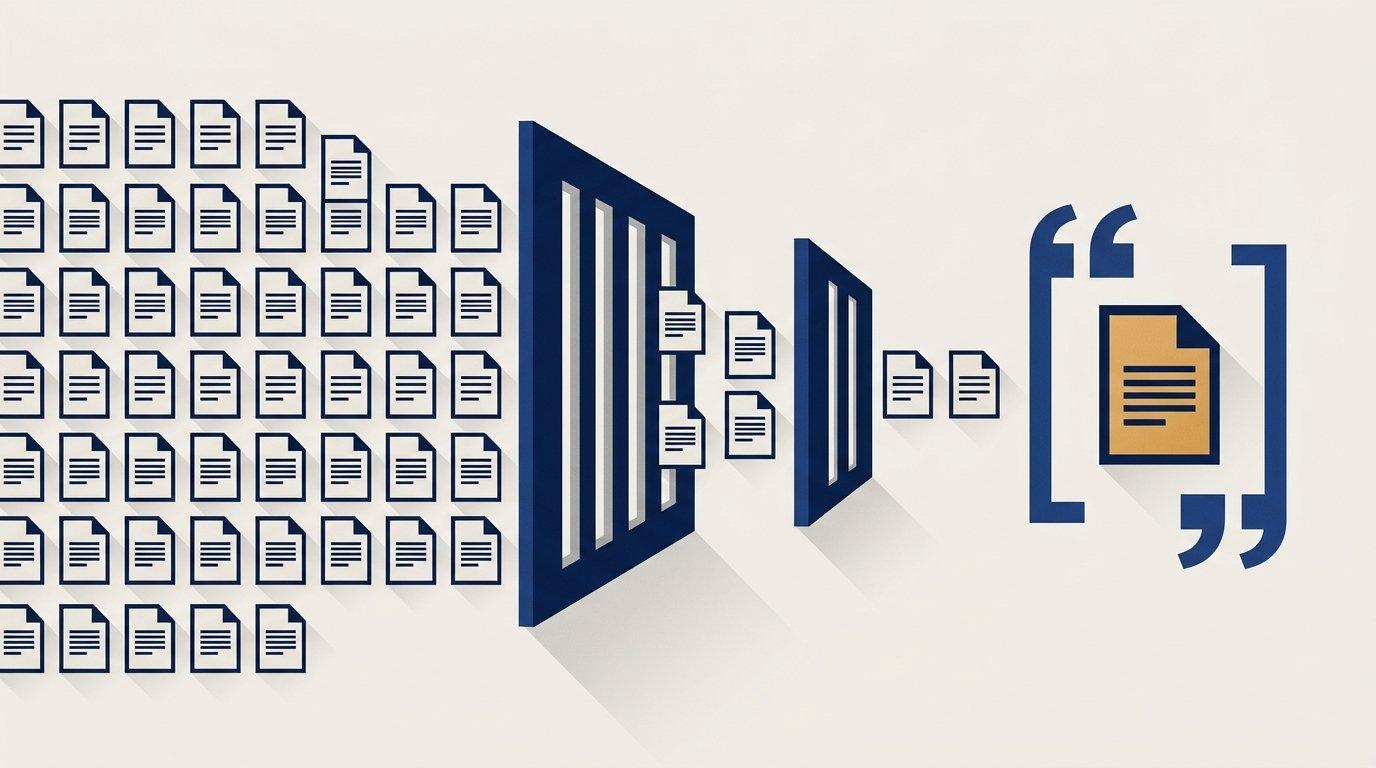
Perplexity decides what to show you in two separate steps, and the two steps reward different work. The first is getting retrieved and cited at all. The second is getting your page to actually shape the words in the answer. A 2026 measurement study of generative search calls these citation selection and citation absorption, and shows they pull on different page qualities. Optimize one and ignore the other and you either never appear, or you appear as a throwaway footnote nobody reads.
Here is what each gate actually rewards, based on data rather than vendor checklists.
How Perplexity builds an answer
Perplexity is a retrieval-augmented system. Every query triggers a live web search. It pulls a set of candidate pages, runs them through a reranker that scores each one for relevance and freshness, then writes an answer with inline citations to the sources it kept. Unlike base ChatGPT, it is not answering from a frozen training set. It is reading the web in real time and citing what it reads.
That design has a direct consequence. The pages Perplexity can cite are the pages its retriever can find and trust right now. So the first question is not how to sound authoritative to a language model. It is whether you are the kind of page this retriever surfaces for your buyer's question. That turns out to be a familiar problem with a familiar fix.
Gate one: Perplexity rewards the pages that already win in Google
Of all the major AI answer engines, Perplexity is the one most tied to traditional search performance. Ahrefs compared brand mention share across roughly 953,000 Perplexity prompts against each site's organic search traffic and found a strong correlation of 0.66, the highest of any AI system they tested. Google's AI Overviews came in at 0.47, and ChatGPT at just 0.33.
Read that the right way. For Perplexity, the sites that earn organic Google traffic are the sites that get mentioned. The retriever leans on the same signals that rank pages in classic search, especially topical relevance and the trust a page earns by already performing well for related queries. There is no secret Perplexity channel that bypasses this. The foundation is the work you would do to rank in Google anyway, which is why the discipline behind our SEO and AEO system and the argument in GEO versus SEO carry straight over.
The blunt version: if your page does not rank for the query in Google, it is probably not in Perplexity's candidate set either. Fix that first. Everything below assumes the page can already compete on the query you care about. Skip this step and the rest is wasted effort on a page no retriever will ever pull.
The brand-mention move you copied from ChatGPT advice is weaker here
A lot of AI-visibility advice tells you to chase brand mentions across the web. For some engines that is sound. Ahrefs found branded web mentions correlated 0.65 with visibility in Google's AI Overviews, a strong relationship. For Perplexity, the same factor correlated only 0.30, a weak one, measured across the same set of nearly a million prompts.
So pouring your whole budget into PR placements and mention-building because a ChatGPT guide told you to is a mismatch for Perplexity. That tactic pays off more where Google's brand bias lives. Perplexity behaves more like a search engine reading pages than like a model recalling reputations, which is the same reason ranking in ChatGPT follows a different rulebook than ranking in Perplexity. Match the tactic to the engine rather than running one playbook everywhere and hoping it transfers.
Earning mentions still has value. The mistake is treating mentions as the main lever for Perplexity, when the data says page-level search performance does most of the lifting.
Gate two: getting cited is easy, shaping the answer is the hard part
Here is the finding most guides miss. Perplexity cites a lot of sources. The same 2026 study found it averaged 16.35 cited sources per prompt, more than Google at 12.06 and well more than ChatGPT at 6.88. Lots of slots means getting cited at all is achievable. It also means a single citation is cheap. You can be source number fourteen, linked once, contributing nothing to the answer the buyer actually reads.
The study measured this with an influence score that tracks how much a cited page's language and evidence show up in the generated answer. Perplexity's average per-source influence was low, 0.0646, while ChatGPT, which cites fewer pages, used each one far more deeply at 0.2713. The practical reading: on Perplexity the gap between being listed and being used is wide, and the work that closes it is different from the work that gets you listed.
Being in the citation list is the entry ticket. Shaping the sentence the buyer reads is the actual win. That second job is where evidence structure earns its keep.
Build pages as evidence containers, not FAQ pages
The study compared high-influence pages against cited-but-ignored ones. High-influence pages were longer, more modular, and more closely aligned with the answer's meaning. They carried extractable evidence: definitions, numbers, comparisons, and step sequences. The two roles that contributed most to answers were definitions and comparisons.
The negative finding matters just as much. Pages built around question-and-answer blocks did not absorb better. Q&A pages scored a mean influence of 0.0947 versus 0.1005 for everything else, slightly worse. The popular advice to bolt an FAQ section onto every page does little on its own. Packaging is not evidence.
For an operator, this turns into a concrete way to build a page:
- Give each section one clear claim, stated up front, so a model can lift it cleanly without guessing.
- Put a usable piece of evidence in each section: a definition, a specific number, a comparison between two options, or an ordered set of steps.
- Write headings that mirror the sub-questions a buyer actually asks, so the page maps to how the answer gets assembled.
- Keep facts traceable to a named source, since transparent evidence is easier for a model to trust and reuse.
I spent five years running marketing at a finance firm where every claim had to survive a CFO reading it. That habit translates almost perfectly to writing for retrieval. A page that states a claim, backs it with a number, and names the source is exactly what both a skeptical buyer and a reranking model are looking for. The same structure that helps you earn placement in Google's AI Overviews is what wins here, which is the point. A page engineered as a clean evidence container tends to win across multiple engines at once. If you want a working starting point, the Demand Engine Checklist lays out the page-level structure step by step.
Measure citation share, not referral clicks
One more shift changes how you judge any of this. When an AI answer satisfies the user, the click usually does not happen. Pew Research tracked real browsing behavior and found that when a search produced an AI summary, users clicked a cited source in only 1% of visits, while 88% of those summaries cited three or more sources. The visibility is real. The referral traffic mostly is not.
So the number that pays is not how much traffic Perplexity sent you. It is how often Perplexity cites you, and for which questions. Track your citation share on the prompts your buyers ask. That tells you whether the foundation work and the evidence-container work are landing, well before any traffic report would show a thing.
One system, not three tactics
Put together, Perplexity optimization is not exotic. Rank the page in Google so the retriever can find it. Build it as an evidence container so it shapes the answer once cited. Measure citation share so you know it is working. Each step feeds the next, and the same pages that win here tend to win in Google's AI surfaces and in ChatGPT too. That is the case for running search, AI visibility, and content as one coordinated system rather than three disconnected projects. The work compounds when it is wired to a single outcome: getting your buyer to a booked call.
