
Key Takeaways
- Perplexity cites pages with 91% domain overlap and 82% URL overlap with Google's top 10 (Semrush, 150,000+ citations). That makes it the most search-aligned of the major AI engines.
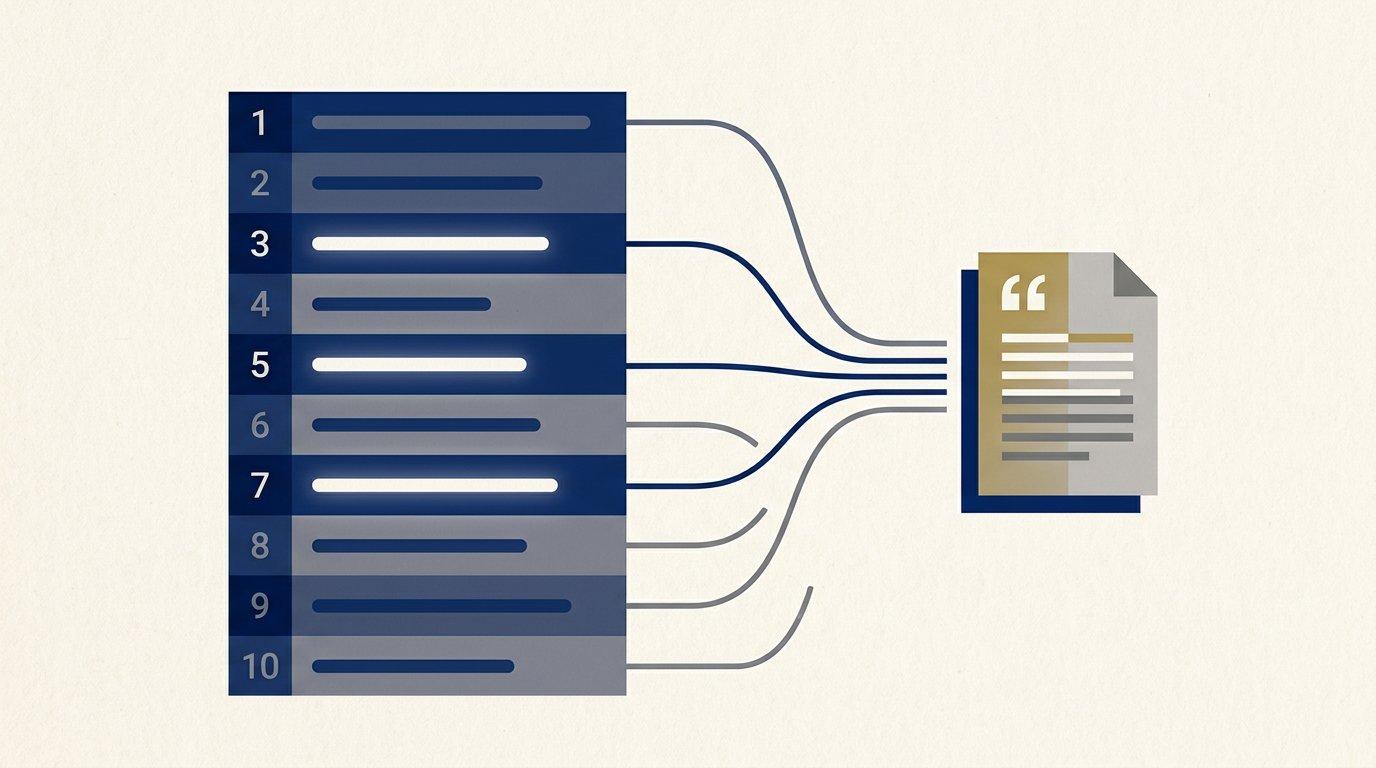
- Inside that overlap, Sonar visits roughly 10 pages per query but cites only three to four. Ranking gets you considered. Citation requires a second filter.
- Three factors separate cited pages from merely-retrieved pages: freshness (AI-cited URLs average 1,064 days old vs 1,432 for organic), brand mention density (YouTube mentions correlate ~0.74 with AI visibility per Ahrefs), and presence on Perplexity's preferred domains: Reddit, LinkedIn, Wikipedia, and Microsoft.
Perplexity is more of a Google mirror than people admit
Most "rank in Perplexity" posts treat it as a new game with new rules. The data argues the opposite.
When Semrush analyzed 150,000+ unique citations across Google Search, Google AI Mode, ChatGPT, and Perplexity from a 5,000-keyword sample, Perplexity had the strongest alignment with Google by a wide margin: over 91% domain overlap and 82% URL overlap with Google's top 10. ChatGPT, by contrast, pulled almost 90% of its citations from URLs ranking position 21+ in Google.
That number reframes the entire conversation. A page that doesn't rank in Google's top 10 is, on the math, very unlikely to be cited by Perplexity. The first move in any Perplexity SEO plan is conventional ranking on the queries you want to be cited for.
This is good news for B2B service firms already investing in SEO and answer-engine optimization as one coordinated system. The work you are doing to rank compounds into Perplexity citation share. It is bad news for anyone hoping Perplexity is a shortcut around Google's authority requirements.
What Sonar is actually doing under the hood
Perplexity's retrieval engine is Sonar, a search-aware generative model that runs live web retrieval, ranks the returned documents, then synthesizes an answer with inline numbered citations. Per Perplexity's own developer docs, Sonar models support tunable search depth (high, medium, low) and are fine-tuned specifically for citation accuracy inside a retrieval context, not just text generation.
The mechanic worth burning into memory: Sonar visits roughly 10 relevant pages per query but cites only three to four. That gap is the entire game. Ranking in Google's top 10 gets you into Sonar's candidate pool. Getting picked from that pool to actually be cited is a second filter, and a stricter one.
So the practical question for any page is not "do I rank?" It's "of the ten pages Sonar already considered, why would it pick mine?"
The three filters that decide which retrieved page gets cited
Across the 2025-2026 research, three patterns separate cited pages from merely-retrieved ones.
1. Freshness
Ahrefs analyzed 17 million citations across ChatGPT, Perplexity, Copilot, Gemini, and Google's AI Overviews. The cited URLs averaged 1,064 days old. Comparable organic SERP results averaged 1,432 days. AI assistants cite content that is roughly 25.7% fresher on average.
Perplexity orders its in-text references from newest to oldest. The same study confirmed it. ChatGPT shows the strongest fresh-content bias of all (cited URLs 393 days newer than organic on average), but Perplexity isn't far behind. The consistent pattern across both: dated content gets retrieved, fresh content gets cited.
For service firms publishing once a month, this is a structural disadvantage. The Sonar pool will include your three-year-old cornerstone post. The citation slot will go to the competitor who refreshed their version six weeks ago. The fix is not "publish more." It is "keep the pages that matter current," with visible updated-on dates and changed substance, not cosmetic edits.
2. Brand mention density off-site
The strongest correlations Ahrefs has found for AI visibility are not on-page SEO signals. In their 75,000-brand study, YouTube mentions correlated ~0.737 with AI visibility, beating branded web mentions (0.66–0.71), branded anchors (up to 0.628), and branded search volume (0.352–0.466). Domain rating, by comparison, correlated 0.266–0.326. Backlink volume barely correlated at all.
The implication for Perplexity SEO: a page about your service competes for the citation slot against pages from brands the model has seen mentioned everywhere else. If you only show up on your own site, you are at a disadvantage against a competitor with the same page who also gets named in a YouTube comparison video, a Reddit thread, and a LinkedIn post. The model treats off-site mention density as a confidence signal about who matters.
This is one of the reasons we wire SEO, outbound, and brand-building together inside the AI Marketing Department rather than running them as separate motions. Citation share is downstream of brand presence, and brand presence is downstream of being talked about in places that aren't your own blog.
3. Presence on Perplexity's preferred host domains
Perplexity has clear domain preferences that show up across every study. Semrush's three-month tracking of 230,000+ prompts found Perplexity's top sources were Reddit, LinkedIn, NIH, Microsoft, and Google. Reddit alone has been credited with double-digit citation share, and YouTube and Wikipedia together account for a meaningful slice of citations.
This is not a hack to game. It's a structural fact about where Sonar finds high-trust signals. For a B2B service firm, the takeaway is concrete:
- A Reddit thread where founders describe what worked for them is a stronger Perplexity asset than a polished blog post on your own domain saying the same thing.
- A LinkedIn article where Joseph names specific cold-email tools by performance carries citation weight a vendor comparison page on your site cannot.
- A YouTube walkthrough of a workflow gets retrieved by Sonar when transcripts are clean and the title matches the query.
Most of these are not SEO deliverables in the traditional sense. They are presence work, and they are the second leg of Perplexity citation share, after baseline Google ranking.
What this means for a B2B service firm's actual workflow
For a B2B services founder still running sales themselves (the firms we build outbound and SEO systems for), the practical sequence is straightforward. None of this is exotic. It is just sequenced correctly.
First, get the underlying page ranking in Google's top 10 for the query you want to be cited for. Without this, Perplexity will almost certainly never retrieve you. Ahrefs' March 2026 update on AI Overview citations vs Google's top 10 found the overlap dropped from 76% to 38% over six months as Google migrated AI Overviews to Gemini 3. Perplexity's overlap has stayed high because Sonar leans on conventional retrieval signals. The 91% domain overlap from the Semrush study is your map.
Second, make sure the page reads cleanly as a citation candidate. Sonar's synthesis step picks pages that give it a quotable, specific, attributable sentence. Vague claims get retrieved and not cited. A page that opens with "outbound performance varies based on several factors" loses to one that opens with "Lavender's 2024 cold email benchmarks put reply rates at 8.5% for 50-word emails versus 1.7% for 200-word." Specific, dated, attributed. That is the prose Sonar rewards. The same discipline applies that we wrote about in How to Rank in ChatGPT, though Perplexity rewards it for slightly different reasons.
Third, build off-site mention density on the platforms Sonar trusts. This is the part most SEO retainers do not deliver, because it's not link building and it's not content. It looks like:
- A founder publishing once a week on LinkedIn, naming specific tools, frameworks, and numbers
- Honest answers in two or three Reddit subreddits where buyers actually ask questions
- A standing YouTube channel, even small, with transcripts that match buyer queries
- Guest appearances on podcasts whose episode pages are indexable
None of this is glamorous. All of it shows up in correlation studies as more predictive of AI visibility than your backlink profile.
Fourth, refresh the cornerstone pages quarterly. Not cosmetic edits. Substantive updates with the current year in the headline, new figures, new examples, and an updated-on date the renderer surfaces. The 25.7% freshness gap Ahrefs found is not a vanity metric. It is the difference between staying in the citation pool and falling out of it.
What you can stop doing
Two things commonly recommended for "Perplexity SEO" don't hold up in the data.
Schema markup. Ahrefs tracked 1,885 pages adding structured-data schema and found AI citations barely moved. Schema helps Google understand your page; it does not appear to be a Perplexity ranking factor in any measurable way. If your CMS already handles it, fine. If you're building a dedicated schema sprint, the time is better spent on freshness and off-site mention density.
Stuffing FAQ blocks for every imaginable query. Perplexity's citation slot goes to pages that answer the query specifically and credibly, not pages that try to answer 40 queries at once. A focused 1,800-word page that earns one citation is more valuable than a 6,000-word kitchen-sink page that earns none.
Chasing "AEO-specific" formatting tricks. Most of the formatting advice in "rank in Perplexity" tutorials (bullet points, short paragraphs, definition boxes) is the same advice that wins traditional featured snippets. Useful, but not Perplexity-specific. The actual Perplexity-specific levers are the three above.
The honest read for B2B services in 2026
Perplexity matters more than its referral traffic suggests. AI search referrals are still around 1% of total web traffic on average per Conductor's 2026 benchmarks, but that traffic converts at roughly 3x the rate of traditional channels in studies from Ahrefs, Microsoft Clarity, and Adobe. The buyer who arrives via a Perplexity citation has already had the comparison conversation. They aren't browsing. They are confirming.
For a B2B service firm with $1-10M revenue, the math is simple: a handful of Perplexity citations on the queries your buyers run before they buy is worth more than a much larger volume of Google clicks on top-of-funnel terms. The work to earn those citations is the work you should already be doing: ranking conventionally, publishing fresh, getting named off-site. Perplexity just rewards the same discipline more concentrically.
That is also why most service firms underperform on Perplexity. The work is spread across SEO, brand, content, and outbound, and most agencies sell one of those four. The citation slot goes to the firms running all of them as one motion.
If you want a structured look at where your own footprint is leaking citation share, our AEO checklist walks the same audit we use internally for client diagnostics.
