
Key Takeaways
- Sales automation software multiplies a process you already trust. It cannot replace having one. MIT's 2025 GenAI Divide study found 95% of enterprise AI pilots produced zero measurable return, almost always from workflow misalignment rather than weak technology.
- The biggest drag on seller productivity is tech-stack complexity, per Salesforce's 2026 State of Sales. Buying one more tool usually adds to the problem it claims to solve.
- For a $1-10M B2B company, sequence automation by what moves booked conversations: outreach and follow-up first, enrichment and reporting behind them. McKinsey found companies under $100M in revenue reach AI scale at roughly half the rate of $5B-plus firms.
- Judge any sales automation by one number: whether booked sales conversations went up the month after you turned it on. If they did not, it is busywork with a subscription fee.
The short answer, before you compare a single tool
Type "sales automation software" into Google and you get ranked lists of platforms. That is the wrong artifact for the decision you are actually making. The question underneath the search is not which product wins a feature bake-off. It is whether automating part of your sales process will book more sales conversations next quarter than you booked last quarter. Most of the time, the software is not what decides that.
Here is the honest version. Sales automation software multiplies a sales process you already trust. Point it at a step that works and it multiplies the output. Point it at a broken handoff and it just breaks that handoff faster, for a monthly fee. MIT's Project NANDA studied this directly. Its 2025 GenAI Divide report found that despite $30 to $40 billion in enterprise spending, 95% of organizations got zero measurable return, and only 5% of custom tools ever reached production. The cause was not model quality. It was tools that did not fit how the work actually happened.
So the useful buying frame is not a tool list. It is a set of questions about your own process, in order. The rest of this article is that frame, written for a founder or small team at a B2B company doing roughly $1 to $10M in revenue.
What sales automation software actually does
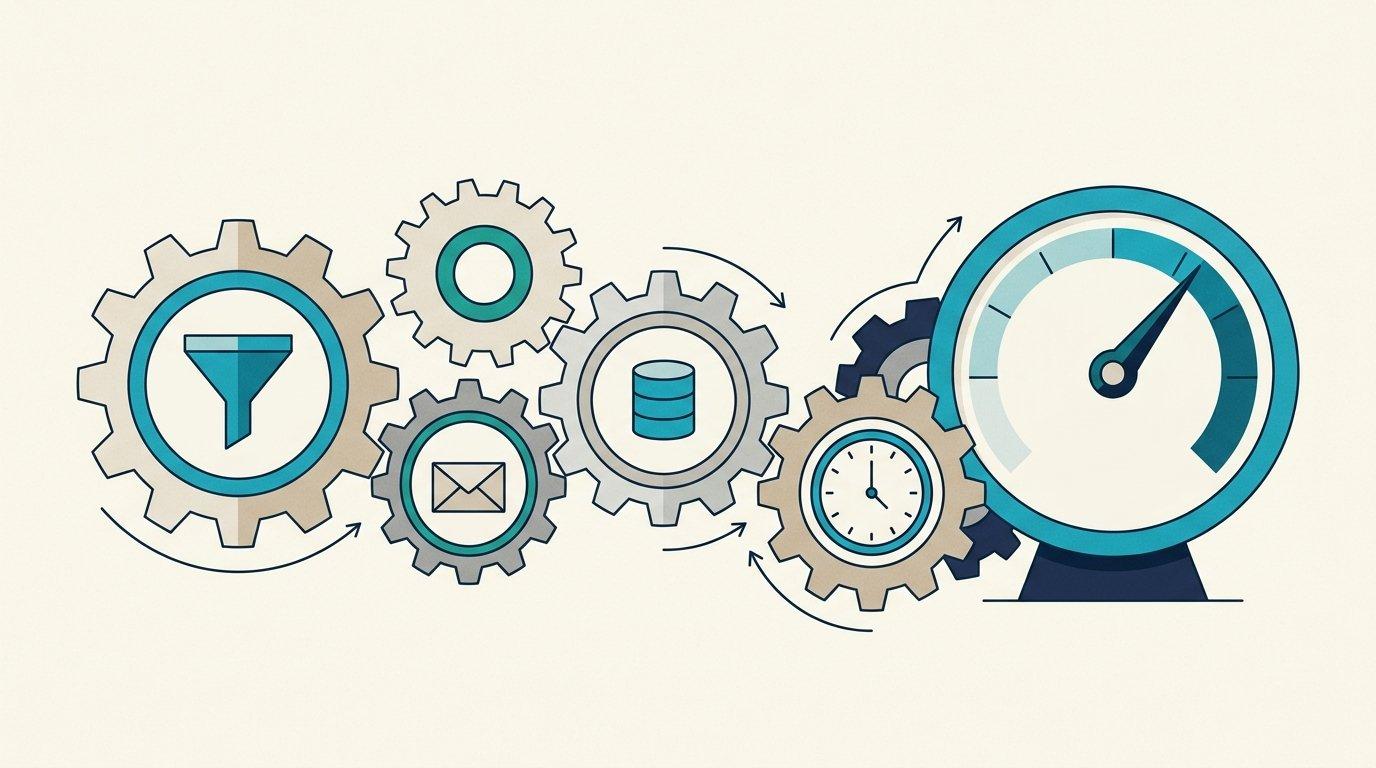
Strip the category down and sales automation software does five jobs. Naming them cleanly matters, because most buyers shop for a product when they should be shopping for a job.
Capture and enrich leads. A form fill, a website visitor, or a list import turns into a complete contact record without anyone typing. Tools like Clay, Apollo, and Clearbit-style enrichment sit here. This is the same machinery covered in AI for sales prospecting, applied to inbound as well as outbound.
Run outreach sequences. Multi-step email and LinkedIn cadences fire on a schedule, with replies pulled out for a human. Instantly, Smartlead, and Lemlist live here.
Keep the CRM clean. Activity logging, field updates, and deduplication happen automatically instead of at the end of a rep's day. This is the heart of CRM automation, and it is the least glamorous and most valuable job on the list.
Drive follow-up. Reminders and no-show recovery run on rules so a deal does not die because someone forgot to send the third email.
Report on what converted. Pipeline, source attribution, and conversion rates update without a manual spreadsheet pull every Friday.
Notice that only two of those five jobs touch the actual selling conversation. The other three are administrative. That is deliberate, and it maps to the real problem. Salesforce's 2026 State of Sales report, drawn from more than 4,000 sales professionals, found reps spend around 60% of their time on non-selling tasks: logging notes and hunting down documents that should already sit in the CRM. Sales automation software earns its budget by giving that time back, not by making anyone a better closer.
Why most of it never moves revenue
If the tools are this capable, why do so many purchases change nothing? Three findings explain it, and they point at the buyer rather than the software.
First, complexity is now the bottleneck. Salesforce names the biggest drag on productivity in 2026 as tech-stack sprawl, and prescribes consolidating tools into one clean workspace for the rep. A founder who buys a sixth point solution to fix a pipeline problem often deepens the exact problem they were trying to solve. Every new login is one more place for data to fragment and one more app to swivel between.
Second, adoption stalls at scale, and it stalls hardest for smaller companies. McKinsey's State of AI 2025 survey found that while 88% of organizations use AI somewhere, only about a third have begun scaling it, and just 39% report any measurable EBIT impact, with most of those seeing under 5%. The gap by company size is stark: nearly half of firms above $5 billion in revenue have reached the scaling phase, versus 29% of firms under $100M. Smaller companies buy the same software and get less out of it, because scaling automation is an operational discipline rather than a license you switch on.
Third, and most important, the failures trace back to fit. MIT's researchers found that generic tools people could try easily did fine, while custom and vendor-sold systems were "quietly rejected" for being brittle and misaligned with day-to-day operations. Their conclusion for buyers who crossed the divide: those companies demanded deep customization, drove adoption from the front lines, and held vendors accountable to business metrics. They treated the purchase as a partnership around an outcome rather than a software subscription.
Read those three together and the pattern is clear. The software is rarely the variable. The process you wire it into is.
Buy the workflow, not the software
The move that separates the 5% who get returns from the 95% who do not is unglamorous: decide what job you are automating before you decide what tool does it.
Salesforce frames its own operating principle as "automate the heavy-lifting, augment the rep, and put the customer in the center." That order is the tell. Automation comes first as a way to remove manual load, not as a strategy on its own. McKinsey found the same thing from the other direction. Its AI high performers, the roughly 6% seeing significant value, were far more likely than everyone else to redesign their workflows around the new capability rather than bolt it onto the old process. The companies that kept the same fields and the same dropped handoffs got a bigger software bill and the same revenue.
For an operator, that translates into a concrete rule. Automation only beats a manual process when the manual process was already clear enough to encode. If you cannot write down, in plain steps, how a lead moves from first touch to booked call today, no tool will fix it. The tool will simply run your confusion at machine speed. Map the process by hand first. Then automate the steps that are stable, and leave the steps that still need judgment to a human until they are stable too.
This is why the honest sequence for most companies starts with a diagnosis, not a demo. Our own AI automation playbook opens with the workflow map for that reason, and the Follow-Up Engine service is built to encode a process you already trust rather than sell you a new one.
A sequencing order for a $1-10M B2B company
Assume you have mapped your process and found the usual leaks. In what order should you automate? Sequence by what moves booked conversations soonest. Ease of purchase is the wrong way to sort the list.
First, outreach. If your calendar is thin, signal-based outbound outreach is the fastest lever, because a sequencing tool can fill a pipeline in weeks rather than months. This is the one place where buying software early pays off, provided the targeting and deliverability are set up correctly underneath it.
Second, follow-up. Most $1 to $10M B2B companies lose more revenue to slow or forgotten follow-up than to weak pitching. Automating reminders and no-show recovery plugs a leak that is already costing you deals you paid to generate. This is close to pure profit recovery, and it is why CRM and follow-up automation belong ahead of anything flashier.
Third, capture and enrichment. Once conversations are flowing, automate the work of turning raw leads into complete, routable records. Enrichment feeds better targeting back into steps one and two, so it compounds, but only after there is volume worth enriching.
Last, reporting. Reporting automation is valuable, but it changes no outcome on its own. It tells you which of the first three steps to fix next. Build it once the pipeline is moving, so the numbers describe a real process instead of an empty one.
The through-line is that these are not four separate purchases. They are one connected system with a single owner and a single scoreboard. A tool bought for step three that does not talk to steps one and two is how you end up back in the complexity trap Salesforce warned about.
How to know your sales automation is working
There is one test, and it is not the vendor's dashboard of tasks automated or emails sent. The test is whether booked sales conversations went up the month after you turned the automation on.
That metric survives the noise. A tool can automate 4,000 activities a week and change nothing about how many qualified prospects agree to talk to you. If the number of booked conversations is flat a month in, the automation is either pointed at the wrong job or wired into a broken step, and no amount of usage data changes that verdict. If the number moved, keep it and automate the next job in the sequence.
Set the cadence deliberately. Baseline your booked conversations for the month before you buy anything. Turn on one job, not five. Measure the same number 30 days later. This is slower than the vendor's onboarding checklist wants you to go, and it is the only way to know whether you bought a multiplier or just bought software. It also keeps you honest about the complexity trade. Every tool you add has to earn its place against that single number, or it comes back out of the stack.
Sales automation software is worth buying. It is not worth buying blind. Decide the job, map the process, automate in the order that moves conversations, and judge the result by the only metric that pays your bills. Do that, and you land in the 5% instead of the 95%.
