
Key Takeaways
- A content brief works like a spec sheet. Under-specify it and you pay in revisions; over-specify it and you get on-brief copy that ranks for nothing.
- A 2026 brief has to spec for two readers: Google's ranking systems and the AI engines that summarize answers. They reward different things, and the brief should name both.
- Define the single job, the SERP baseline, the buyer's question cluster, the proof, and the definition of done. Those five fields remove the guesswork that turns one draft into four.
A brief is a spec sheet
A content brief is the document that decides whether a page ranks and gets cited, finished before the writer opens the draft. Most teams treat it as a formality. They copy a template with eleven sections, fill in the obvious fields, and hand it off. The template is the easy part. The spec discipline behind it is what separates a page that earns its position from one that fills a keyword gap.
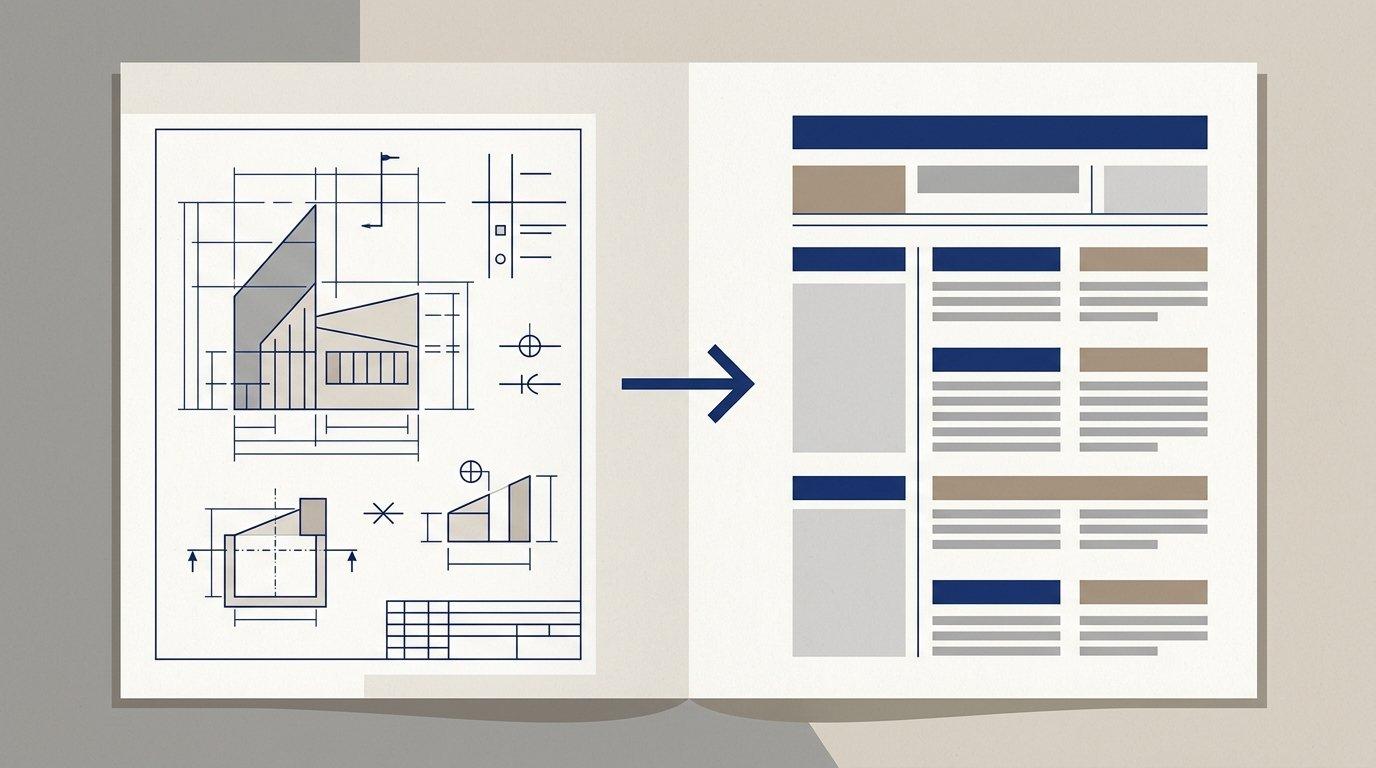
Think of it the way a machine shop thinks of a spec sheet. The sheet tells the floor what "in tolerance" means before the first cut. A content brief does the same job for an article: it removes the decisions a writer would otherwise guess at, and it sets the bar the finished page has to clear.
That framing exposes the two ways briefs fail. The under-specified brief gives a title, a keyword, and a word count, then leaves the writer to guess the angle and the depth. You find out the guess was wrong after the draft exists, which is the most expensive moment to find out. Google is direct about the bar a page has to clear. Its guidance on creating helpful, reliable, people-first content asks whether a page provides "original information, reporting, research, or analysis" and whether it is the kind of page someone would want to "bookmark, share with a friend, or recommend." A brief that hands over a keyword and a word count has said nothing about how to clear that bar. The over-specified brief fails for the opposite reason, which is worth its own section below.
The eight fields a working brief actually needs
Here is the template we use. It is eight fields, and every one exists to kill a specific kind of guesswork.
- Page basics. Primary keyword, working title, URL slug, content type, and the one reader this page is for. Not a persona category. One reader with one problem.
- The single job. What the reader should be able to do after reading, written in one sentence. State one job. A brief with three competing goals is a brief with none, because the writer will quietly optimize for whichever one is easiest to write.
- The SERP teardown. The top three to five ranking pages, read through the lens Ahrefs calls the three Cs of search intent: content type, content format, and content angle. Name the pattern the SERP is rewarding, then state where this page goes further. For this very keyword, the teardown is plain: the top results are all downloadable templates with the same eleven labeled sections. The baseline is "here are the fields." The angle that beats it is treating the brief as a control system with a point of view about which fields earn their place. The instruction is to beat the baseline, never to copy it.
- The buyer's question cluster. The actual questions the page has to answer, pulled from People Also Ask and the related searches. This is the difference between a page that mentions a topic and a page that resolves it.
- Proof and sources. The specific claims that need a citation, and where a credible source lives. Google treats trust as the most important part of E-E-A-T, so the brief should point the writer at real evidence before they reach for a vague "studies show."
- The outline with intent notes. H2s and H3s, with one line under each on what that section has to accomplish. A heading on its own is a guess dressed up as structure.
- The on-page spec. Meta description direction, title tag, slug, and the internal links to include, listed by URL so the writer is not hunting for them.
- The definition of done. The short checklist an editor runs before the page ships. If you do not have one, our Demand Engine Checklist is a usable starting point.
Most downloadable templates stop at field seven and treat the outline as the deliverable. The first two fields and the last one do most of the work. They are also the fields people skip, because they take judgment rather than copy-paste.
Spec for two outcomes: the Google ranking and the AI citation
A brief written in 2026 has two readers. The first is Google's ranking systems. The second is the AI engines that read the page and decide whether to quote it in an answer. They reward different things, and a brief that only thinks about the blue link is half a brief.
For Google, the steer is the Who, How, and Why test in its content guidance. Make authorship obvious and be transparent about how the piece was produced. Above both, write the page to help a person rather than to catch a search query. Google calls the "why" the most important question of the three, and it weights trust above the rest of E-E-A-T. A brief operationalizes that by naming the author, pointing at the evidence, and stating the reader's real problem in plain terms.
For AI engines, the steer is density. Dan Petrovic's study of more than 7,000 queries, covered by Ahrefs, found that the slice of a page an AI engine actually pulls from when it builds an answer plateaus at roughly 540 words and stays close to constant whether the page is short or long. Pages past 2,000 words dilute their own coverage rather than adding to it. The conclusion Petrovic draws is that density beats length. A page wins the citation by being the most relevant source for a query. Once coverage plateaus, extra length works against you.
The brief turns that into two instructions. First, name the answer block: the 40 to 60 word direct answer to the keyword's underlying question, placed near the top where both a reader and an engine can find it fast. Second, name the question cluster the page covers, so the writer builds breadth that earns citations across related queries instead of padding one. Neither instruction shows up on a standard template, which is why standard templates produce pages that read fine and get summarized by nobody. We go deeper on this split in our post on winning AI Overview citations, but the brief is where the decision gets made.
The instructions that quietly wreck a brief
The over-specified brief is the failure nobody warns you about. When the brief writes every sentence, you get copy that is perfectly on-brief and ranks for nothing, because the writer had no room to bring an example, a number, or a point of view the SERP had not already seen. A good brief sets the structure and the bar, then leaves the writer the judgment that makes a page worth reading.
Keyword rules are the usual culprit. An instruction like "use the primary keyword in the H1, the first paragraph, and at least two H2s" reads as precision and produces stuffing. State the keyword and the reader once, and trust the writer to place it where it reads naturally.
This matters more now that AI sits inside most drafts. HubSpot's research on AI in content marketing found that only 7% of marketers publish AI output without editing, while 56% heavily revise or rewrite it, and 43% have run into AI generating inaccurate information. The brief is the thing that makes an AI first draft worth editing instead of worth scrapping. A vague brief plus an AI draft stacks two layers of guesswork on top of each other, and the editor pays for both.
Wire the brief into the system
A brief earns its keep when it points at one number. For the firms we work with, that number is booked sales calls. Every field traces back to whether the page brings in a buyer who books a call. A word count target cannot answer that question. The keyword, the angle, the question cluster, and the internal links can: they all decide whether the page moves someone closer to a conversation.
Across five years running marketing at CFO Hub, the brief was the unit of quality control. It was the one place to fix a recurring problem once, in the spec, instead of catching it in every draft after the fact. That is the whole argument for taking the brief seriously: a fix in the brief costs minutes, and the same fix in a finished draft costs a rewrite.
A brief should not live as a one-off doc that dies in a folder once the post ships. It is one step in a repeatable run: brief, draft, review against the definition of done, publish, measure, feed what you learned back into the next brief. That is how the SEO and AEO work we run stays consistent as volume climbs, and it is the same logic behind treating content, outbound, and follow-up as one coordinated marketing system rather than separate projects. A standardized brief is what lets you add a writer, or an AI assist, without quality sliding. It is also why content briefs sit inside a larger B2B SEO strategy instead of floating next to it.
The brief is the cheapest place to improve a page, because it is the only point in the process where a problem costs minutes to fix. Spend the thirty focused minutes there and most of the revision cycle disappears. Skip it, and you pay the cost downstream every single time, in extra drafts and editor passes that stack up on pages that still rank for nothing.
