
Key Takeaways
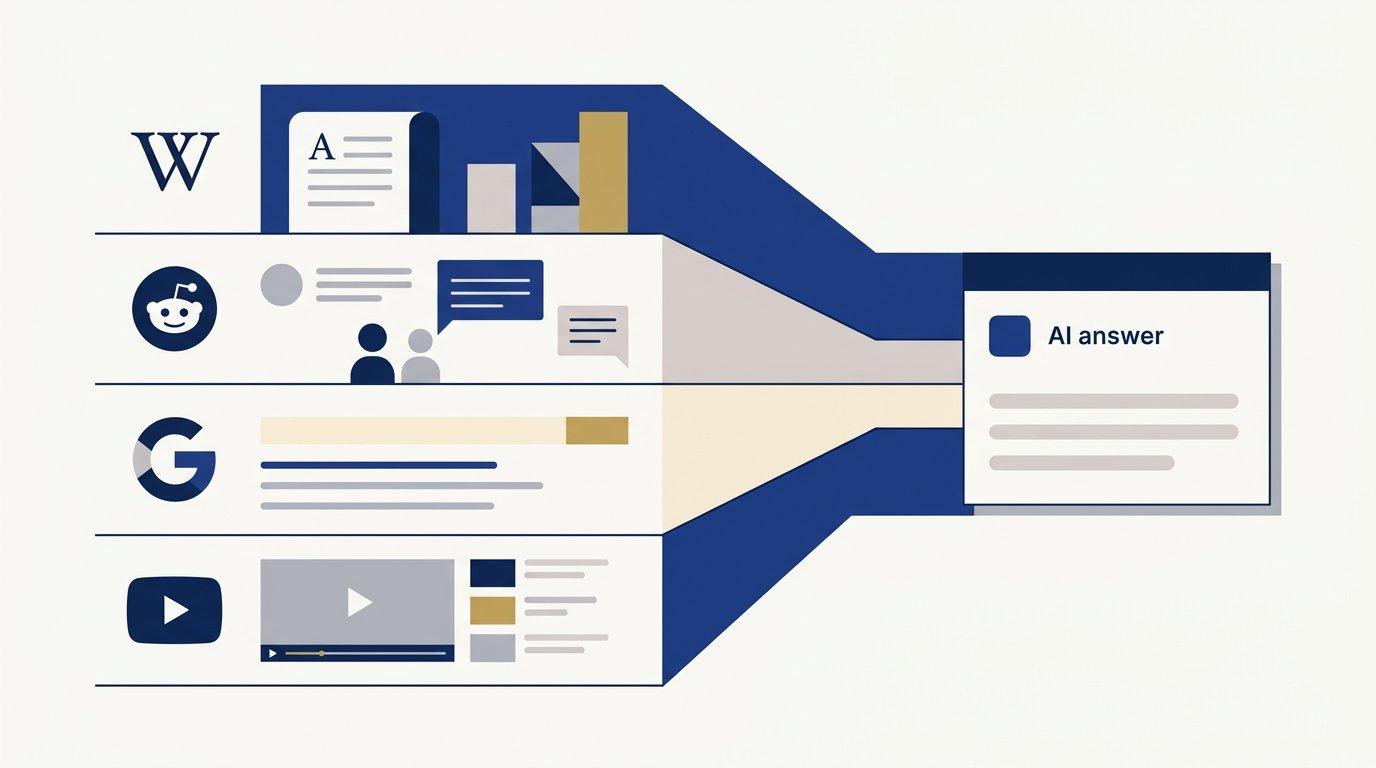
- AI engines pick citations to minimize risk, not maximize relevance — they reach for sources they can repeat without being wrong, which is why community-edited and brand-mentioned content wins.
- Brand web mentions on third-party sites correlate with AI visibility at 0.664 — about three times stronger than backlinks (0.218). 90–95% of AI citations come from external sources, not your own pages.
- There is no single 'AI search' channel. ChatGPT pulls from Bing plus Wikipedia, Perplexity weighs Reddit heavily, Google AI Overviews still overlap ~50% with the top 10 organic results, and Google AI Mode has its own retrieval logic.
- Princeton's GEO paper measured that adding statistics lifts visibility 41%, expert quotations 28%, and citing external sources 115% for lower-ranked pages. The on-page work that actually moves citations is unfashionable: data, quotes, schema.
- Citation share is volatile by month and platform. Measuring it weekly across 20–30 target prompts is the only way to know if any of the work is compounding.
The 7-tactic playbook is the wrong unit of analysis
Search "how to rank in AI search" and you get the same article seven different ways: add schema, write FAQ pages, refresh content monthly, build Reddit presence, get into Wikipedia, lead with the answer, optimize for E-E-A-T. None of it is wrong. All of it is downstream of a question the playbooks rarely ask: what is the system actually doing when it picks a citation?
The honest answer is that AI engines are not running a ranking algorithm. They are running a risk-minimization step. When ChatGPT or Perplexity or Google's AI Mode synthesizes a response, the retrieval pipeline pulls a candidate set of documents, and the model picks the citations it can most safely repeat without being factually wrong. That sounds like a small distinction. It is the whole game. It explains why Wikipedia is the most-cited source on ChatGPT, why Reddit captures a plurality of Perplexity citations, why brand mention volume on third-party sites predicts AI visibility better than the backlinks people have spent two decades chasing, and why the same page can move from cited to uncited in three weeks without you changing a word.
The second thing the playbooks get wrong is treating "AI search" as one channel. There are at least four engines that matter right now (ChatGPT search, Perplexity, Google's AI Overviews, and Google's AI Mode), and each one draws from a different retrieval substrate. Optimizing for "AI" without naming which engine is like optimizing for "the internet." The work is real, but it has to be sequenced by which substrate you are losing on.
Why citation logic looks the way it does
Traditional SEO asks "what is the best page for this query?" Generative engines ask "what is the safest sentence I can produce, supported by sources I can name?" The model is incentivized to pick references it recognizes from training, that other authoritative sources also cite, and that read as factual rather than promotional. ZipTie's analysis of how AI citation selection works frames this as a fundamentally different objective function: pattern recognition across a body of trusted text rather than relevance ranking against a single query.
That objective function has three direct consequences for what wins citations:
Authority is read at the domain level, not the page level. Semrush's AI visibility study found that domain-level Google ranking strength correlates strongly with AI citation volume, but the URL-level overlap is loose. ChatGPT often cites pages ranking beyond position 21 on Google, pages on domains it trusts, just not the specific URLs Google promotes. AI engines are picking from a domain's full library, not just its top-ranked page.
Community-edited sources outrank corporate marketing. Across five verticals Semrush analyzed in its most-cited-domains study, Wikipedia and Reddit consistently outrank brand-owned websites. A separate Search Engine Land report on which sources AI engines cite most found Reddit, YouTube, and LinkedIn at the top, with Reddit leading at roughly 40% citation frequency across 150,000 citations sampled. Risk-minimization favors content that already has thousands of human readers agreeing it is approximately correct.
Promotional tone is penalized. Semrush's content-only study identified five qualities that positively correlate with citations (answer-first structure, expertise signals, structured formatting, original data, freshness) and one quality that negatively correlates: non-promotional tone. If your page reads like a brochure, it gets passed over.
The four engines pull from different substrates
The reason a single playbook misleads is that the four engines that matter overlap less than people assume.
ChatGPT search pulls from two pools: its training corpus (older, snapshotted) and live web retrieval through SearchGPT, which uses Bing's index as its primary web source. Wikipedia is ChatGPT's heaviest single citation source. The operator implication: a Bing Webmaster Tools profile and a clean Wikipedia footprint matter for ChatGPT in a way they do not matter for Google AI Overviews.
Perplexity crawls in near real time and weights community content heavily. Reddit citation share spiked above 40% on Perplexity in 2025 before falling sharply when Reddit sued Perplexity over scraping in October. Perplexity's Reddit citation share dropped roughly 86% almost overnight, with YouTube filling the gap. Two lessons: fresh content gets pulled quickly, and community substrate is high-yield but volatile.
Google AI Overviews still overlap roughly 50% with the top 10 organic results for the same query. AI Overviews appear on roughly 25–40% of result pages depending on category and cite an average of 3–5 sources per query. The fastest path to AI Overview citation is to rank organically and add the answer-first formatting AI Overviews favor. This is the engine where classical SEO still pays the rent.
Google AI Mode is the newest substrate and uses its own retrieval logic, less anchored to the top 10. Semrush's AI Mode comparison study found that AI Mode citations skew toward domains with strong structured data implementation, Article and Organization schema in particular. Treat AI Mode like a separate engine that happens to share Google's name.
For a deeper look at how the underlying retrieval substrates compare for Perplexity specifically, the Perplexity SEO breakdown walks through the 91% domain / 82% URL overlap Semrush observed with Google's top 10. Perplexity ranking is mostly a question of being one of the ~3-4 cited from an already-retrieved set.
Brand mention surface area is now the strongest predictor
The single most uncomfortable finding from the 2025 data is that brand mentions outside your site predict AI citations more strongly than anything you do on your own site. Evertune's analysis of more than 10 million AI interactions found brand web mentions on third-party sites correlate with AI visibility at 0.664, versus 0.218 for backlinks. The same dataset found that brands in the top 25% for web mentions earn over 10x more AI citations than the next quartile. SE Ranking, working from a separate dataset, reported that domains with millions of brand mentions on Quora and Reddit have roughly four times the citation rate of domains with minimal community activity.
The follow-on number is the one most operators miss: 90–95% of AI citations come from external sources, not from a brand's own website. Almost everything that makes you visible to AI search is happening on other people's properties: Reddit threads where someone names you, podcast transcripts where you are quoted, comparison posts on industry sites, Wikipedia pages, YouTube videos that embed your data. The "build it on your blog and they will come" model fails here because the model is not optimizing for your blog.
The practical move is to stop separating PR, brand, and SEO budgets. The metric that matters is unique third-party domains mentioning the brand, weighted by how often AI engines reach for those domains. Joe's CFO Hub experience watching marketing budgets allocated by channel rather than by retrieval substrate is exactly the structural mistake that breaks AI visibility today. The work compounds across what used to be three separate scoreboards. For service firms running this as one coordinated system, the AI marketing department service handles the on-page citation density and the off-site mention surface as one engine, not two budgets.
On-page changes that still move the needle
External signal volume dominates, but on-page work is not zero. Princeton's GEO paper, the first peer-reviewed research on generative engine optimization, ran six modification strategies across 10,000 queries and measured which changes lifted citation visibility:
- Adding statistics: +41% visibility
- Adding expert quotations: +28% visibility
- Citing external authoritative sources: +115% visibility for lower-ranked pages
- Combining several modifications stacked higher gains, particularly for content below position 5
The on-page work that earns citations is data, quotes, and outbound references. That is the opposite of what most SEO playbooks teach. Most content is written to keep readers on the page. AI engines reward content that links out to authoritative sources because that is how the model verifies the page is itself drawing from trustworthy material. Outbound citations are not link equity leaks; they are evidence of work.
Evertune's positioning research adds a second lever: brands mentioned in the first two sentences of an AI response receive roughly 5x more downstream consideration than brands mentioned later. That maps directly to the answer-capsule rule: write the first paragraph as a self-contained answer to the question the page targets, name the entities the buyer cares about, and put the strongest claim in the lede. Backlinko's analysis of pages with answer capsules versus pages without saw a 40% citation rate gap.
Structured data is the unglamorous compounder. Organization, Article, BreadcrumbList, FAQPage, and HowTo schema appear at much higher rates on AI-cited pages, particularly for Google AI Mode citations. For services firms, the Article and Organization schema does most of the work. For product or tool comparisons, FAQPage and HowTo become the differentiators.
Traditional ranking is still the floor
A reasonable reading of the data above is "stop doing classical SEO." That reading is wrong. The Semrush domain-level data is unambiguous: domains that rank in Google's top 10 for many queries are dramatically more likely to be cited across every AI engine. Google AI Overviews overlap 50% with the top 10 organic results. Perplexity's domain overlap with Google's top 10 is around 91%. AI engines are not replacing traditional ranking signals; they are layering a citation-selection step on top.
The full picture, covered at more depth in the GEO vs SEO breakdown, is that classical ranking is the precondition. Rank in the top 10 to be in the candidate set; then the citation-selection layer decides which of the 10 the AI engine actually quotes. Skipping the ranking work to chase Reddit mentions is a strategy that produces brand impressions in two AI engines and zero traffic in any of them.
For services firms working B2B, the floor is the cluster of supporting pages on a real SEO foundation. The SEO and AEO service page handles that base layer; the citation-selection layer sits on top. If you want a structured way to audit your own setup, the SEO and AEO checklist is the version we use with clients.
How to measure whether any of this is working
The volatility data is the part most teams underestimate. Reddit dropped from roughly 60% of top ChatGPT citations to about 10% by mid-September 2025, according to Semrush's tracking. Wikipedia dropped from being in 55% of ChatGPT prompt responses to under 20% in the same window. Conductor found Reddit citation share dropped 23% in a single month between October and November 2025. Only about 30% of brands hold consistent AI visibility across back-to-back queries on the same platform.
The measurement protocol that survives that volatility is simple and weekly. Build a prompt panel of 20–30 queries a buyer would actually type, mixing branded, comparative, and informational variants. Run the panel against ChatGPT search, Perplexity, Google AI Overviews, and Google AI Mode, ideally in a clean session to minimize personalization. For each prompt, record whether the brand was mentioned, whether it was cited with a link, what competitors were cited, and what types of sources the model reached for (Reddit, Wikipedia, comparison post, official docs, etc.). Track citation share over time, not a snapshot. A brand that wins 25% of branded prompts and 5% of non-branded prompts knows exactly which problem to fix.
The lift trajectory most B2B brands see when this is run as a coordinated system is citation share moving inside 8 to 12 weeks, but only when on-page citation density, third-party brand mentions, and traditional ranking are being worked at the same time. Run them as three sequential projects and the gains do not compound. Run them as one operating system and they do.
